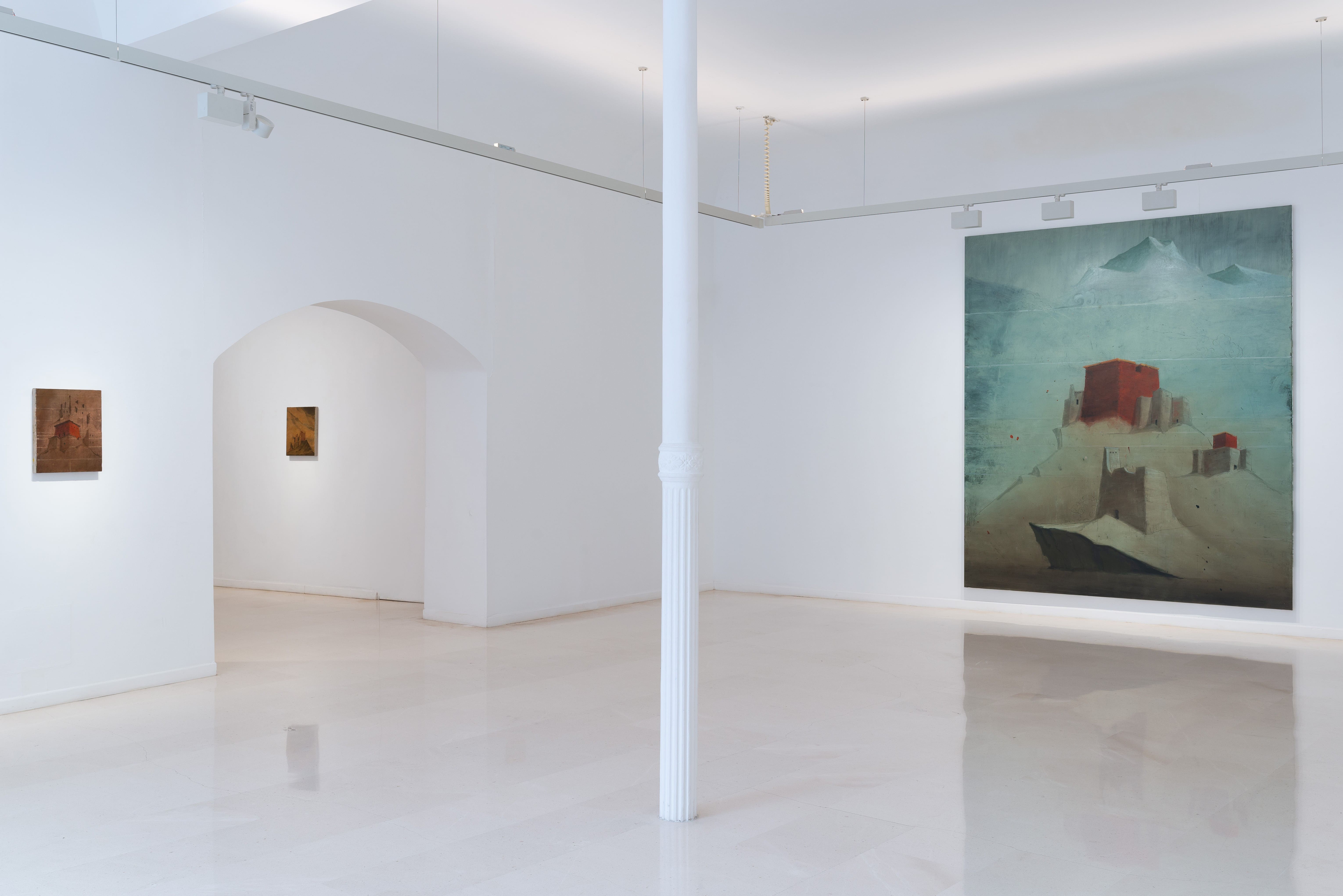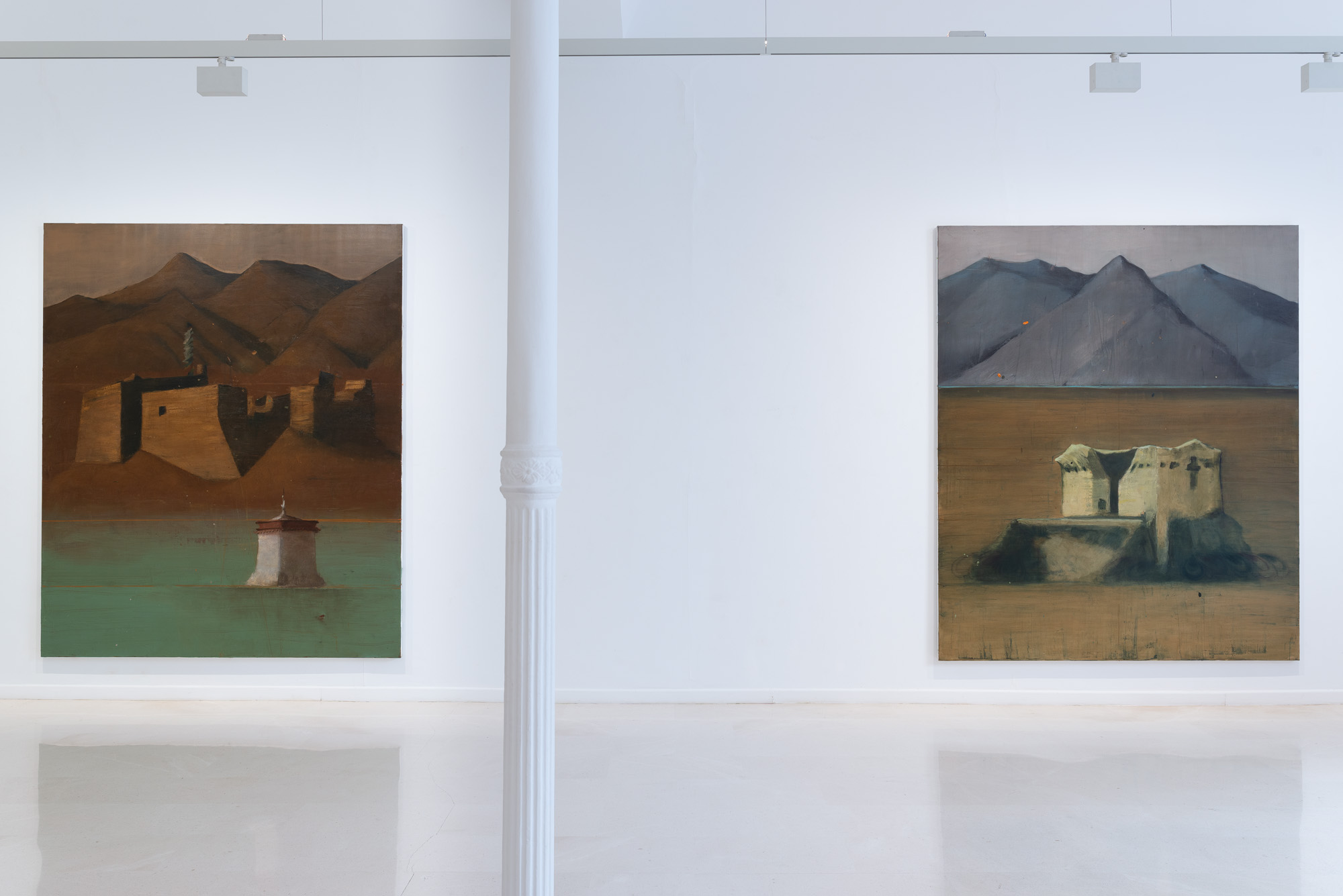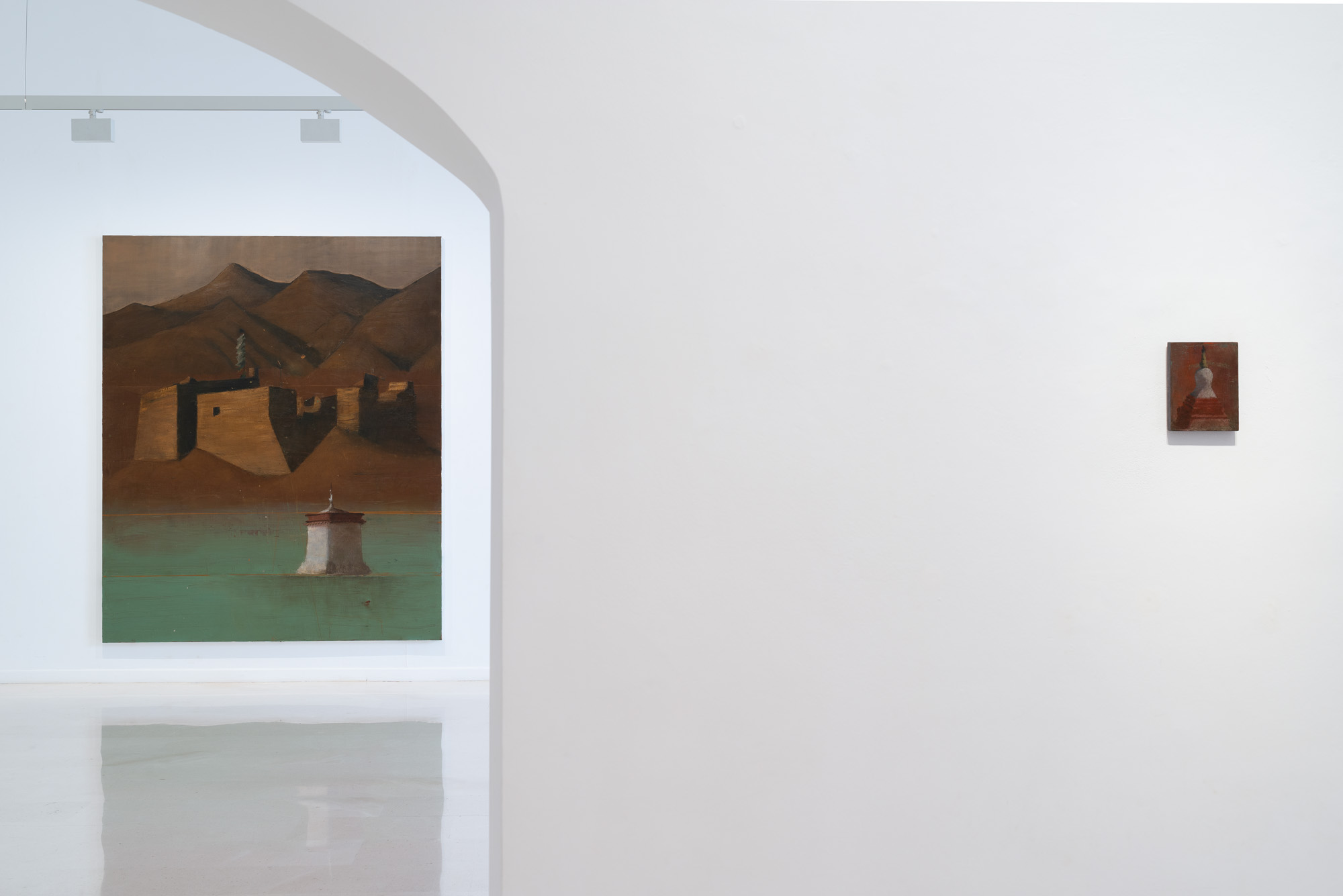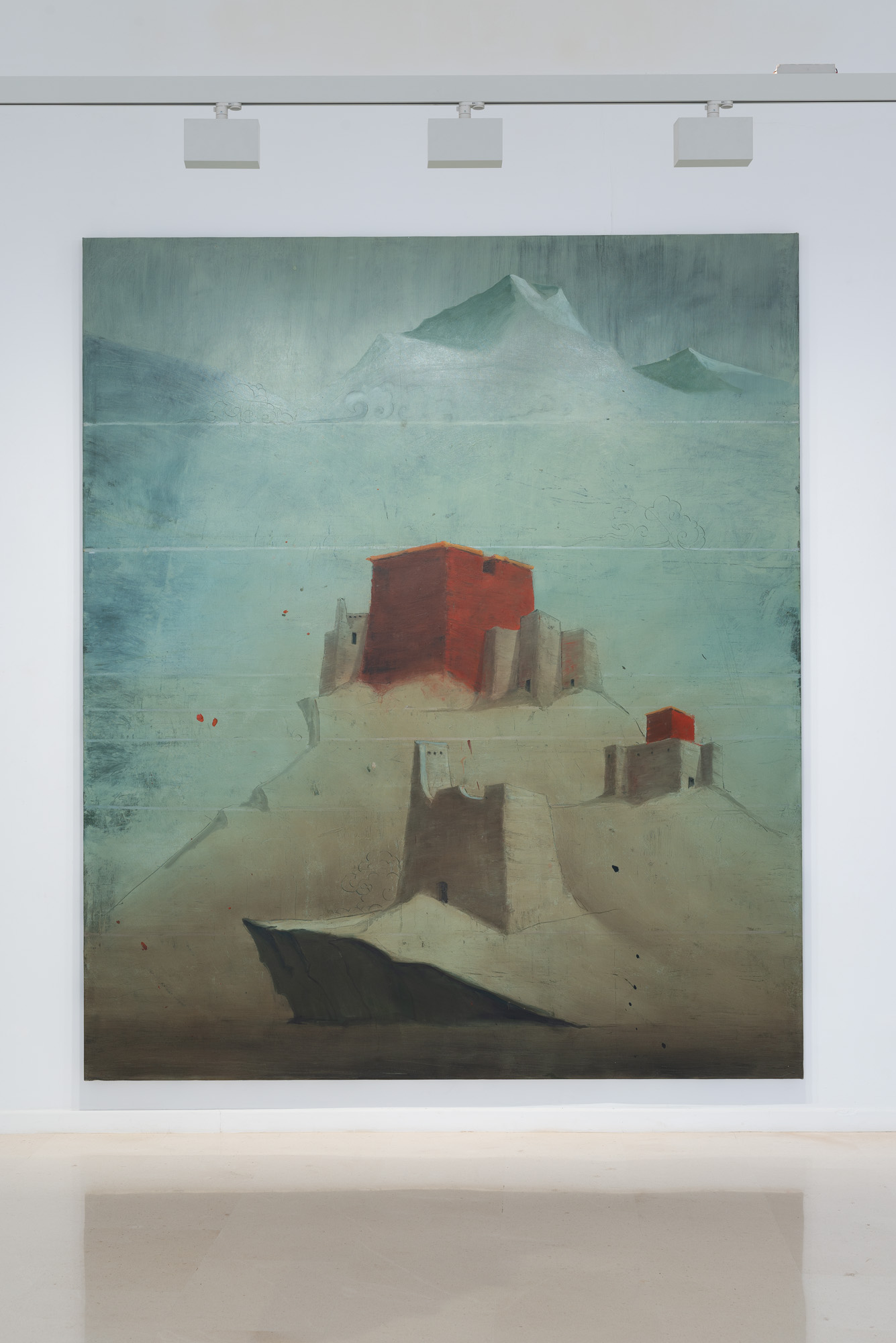
From June 5 to September 11, 2025
Alejandro Campins' first solo exhibition on the ground floor of Galeria Pelaires
As Rudolf Arnheim has pointed out, given the nature of how we process visual-spatial information, our minds spontaneously organize what we see into hierarchical relationships of dependency: some things are understood as frameworks, others as framed within those
frameworks; some things are containers, others are contained. We perceive the mosquito as attached to the elephant, not the elephant attached to the mosquito. This involuntary assigning of hierarchically dependent structures extends to our perception of non-spatial
'spaces' as well: temporal space, psychological space, intellectual space, familial space, emotional space, energetic space, spiritual space. Some things are frameworks, others framed within those frameworks; some things are containers, others contained.
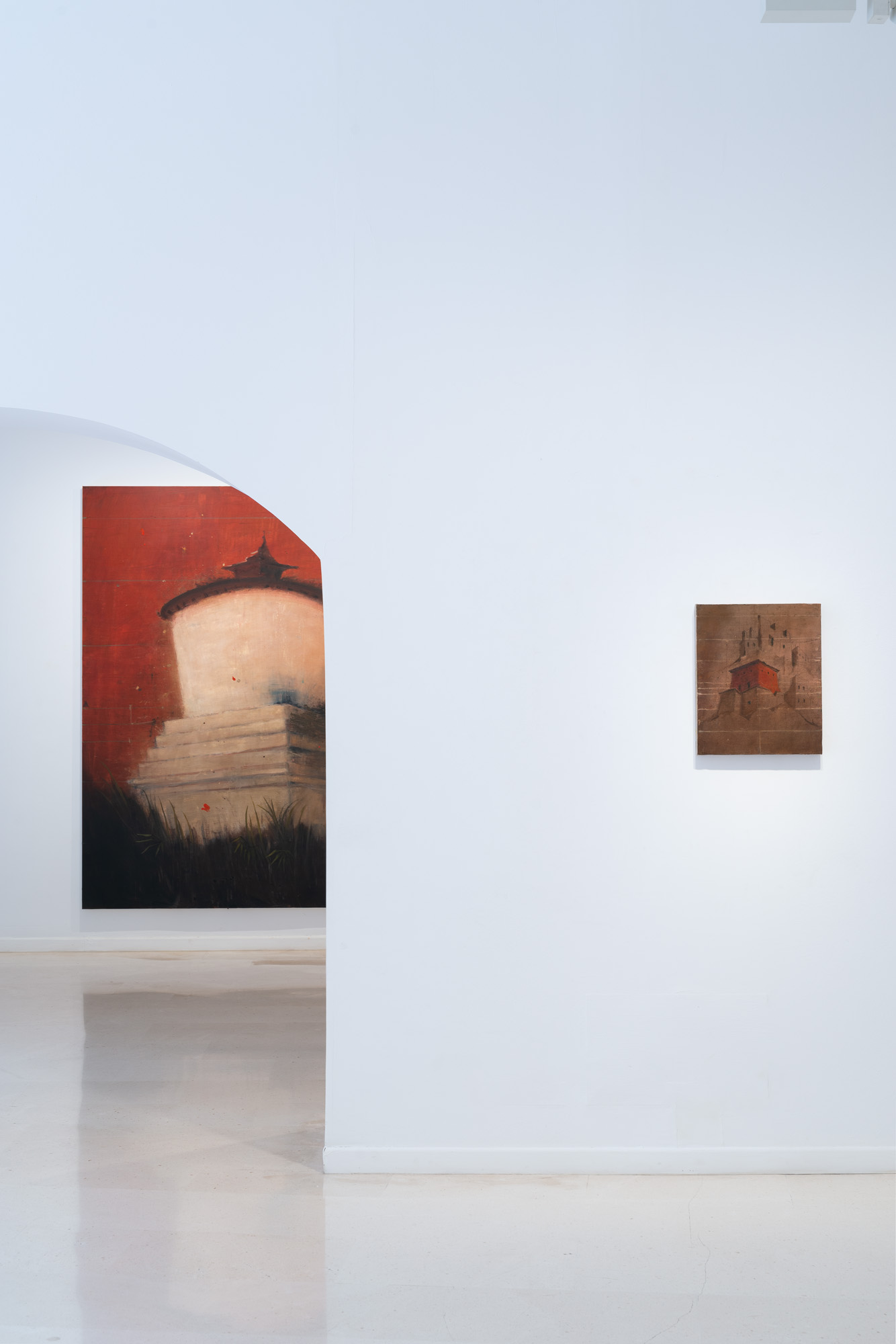
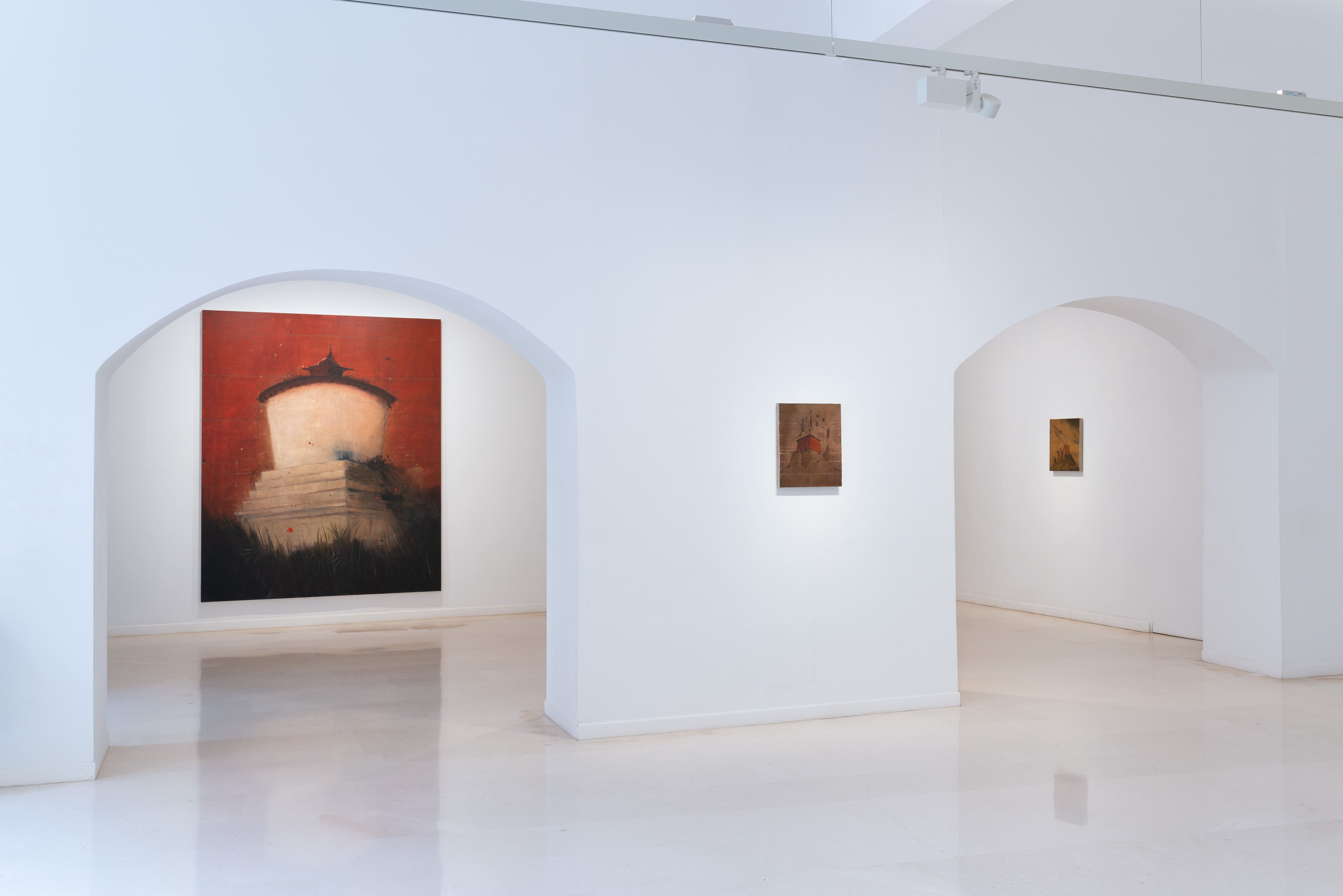
The paintings in Alejandro Campins's exhibition Ni mundo interior ni mundo exterior (Neither Inner World Nor Outer World) at Galeria Pelaires offer an alternative to this deeply ingrained phenomenon. In compositional terms, the works on view follow a basic format; they depict isolated architectural structures and sheer landscapes. The structures are in varying states of ruin, decay and destruction; the landscapes are uncluttered and rather desolate. We can recognize the structures as stupas, or Buddhist religious and symbolic structures; we know from the titles of the works (they belong to Campins's series Tibet) that the landscape is that of the Himalayas, and specifically the geographical region popularly known as the "Roof of the World", the world's highest and largest plateau.
Central to Campins's particular method of depiction of these basic elements is that we cannot say (as we habitually would) that the objects are in the landscape; the objects are with the landscape, and the landscape is with the objects. Notions of framework and framed, of container and contained, do not apply; they are equals, sharing a single, organically fused visual field in which the operative relationship is more conjunctional than prepositional. This effect is achieved not only through the shifts of perspective and the simplicity of the composition, but also via the method of execution — i.e, the way Campins paints, as much as what he paints. The surfaces are everywhere extensively yet delicately layered; there is little overt delineation, but rather a ubiquitous blending and melding; the color range is muted and restrained, bracketed by tones of earth and sky.
Taken together, the subject matter and mode of execution of the paintings in Ni mundo interior ni mundo exterior alert us that Campins is not only depicting physical objects and space, but rather, and in consonance with Tibetan Buddhism, spiritual and energetic space. And yet these images are not illustrations of Buddhist thought, but rather an artist's attempt to translate, and in the process of translation to transmit, that thought. As a result, the dependent notion of framework and framed, of container and contained, is subverted not only with regard to what is depicted, but even with regard to the painting itself, the oil and pigment and canvas as much as the stupas and earth and sky: it is one.
Text by George Stolz
____
Alejandro Campins (Manzanillo, Cuba, 1981) lives and works between Madrid and Havana.
These paintings conjure dreamlike states and spaces of uncanny landscapes and ambiguous structures. In Campins's work, technique and imagery come together to evoke otherworldly atmospheres that suggest emptiness but at the same time seem filled with a psychological charge that is as powerful as it is elusive. Executed primarily in oil paint (as well as with watercolor and pencil), Campins's work displays a classically grounded command of line and composition and a heightened sensibility for chromatic hues and overtones. His brushwork is subtle but assured and his use of color is muted but finely calibrated, yielding veiled and seemingly weathered surfaces that echo the content of the paintings' imagery. In Campins's work, there is a sense that past and future are overlaid, remembrance and imagination are intertwined, permanence and impermanence co-exist.
Alejandro Campins studied at the Academia Profesional de Artes Plásticas El Alba (Holguin, 2000) and the Universidad de las Artes (ISA) (Havana, 2009).
Campins has exhibited individually at Fondazione Giuliani (Rome, 2021); at Centro Wilfredo Lam (Havana, 2018); at Fototeca de Cuba (Havana, 2016); at Factoria Habana (2012) and at Fundación Ludwig (Havana, 2008).
He has participated in group exhibitions at UNAICC - Unión Nacional de Arquitectos e Ingenieros de la Construcción de Cuba (Havana, 2017); at Franco Parenti Theater (Milan, 2017); at the Walker Art Center (Minneapolis, 2017); at The Museum of Fine Arts (Houston,2017); at the Museum of Art and Design (Miami, 2016) and at the Museo Nacional de Bellas Artes (Havana, 2013).
Campins was invited to participate at the 13th Bienal de la Habana (2019), the 58th Biennale di Venezia (2019) and the 11th Bienal de la Habana (2012).
Some of his works are in collections such as the Banco de España (Madrid), Museo Nacional de Bellas Artes (Havana); Voorlinden Museum (Wassenaar); Pizzuti Collection (Columbus); Maison Européenne de la Photographie (Paris) or Daros Latinamerica Collection (Zurich).
__
Project in collaboration with Galería Elba Benítez.
La Galeria Pelaires ha rebut una subvenció del Consell de Mallorca per a la realització d'aquesta exposició.