.
From March 21st to May 27th, 2026

Individual exhibition by Tomás Pizá on the Pelaires Cabinet.
Unyevunyevu
Jaume Reus
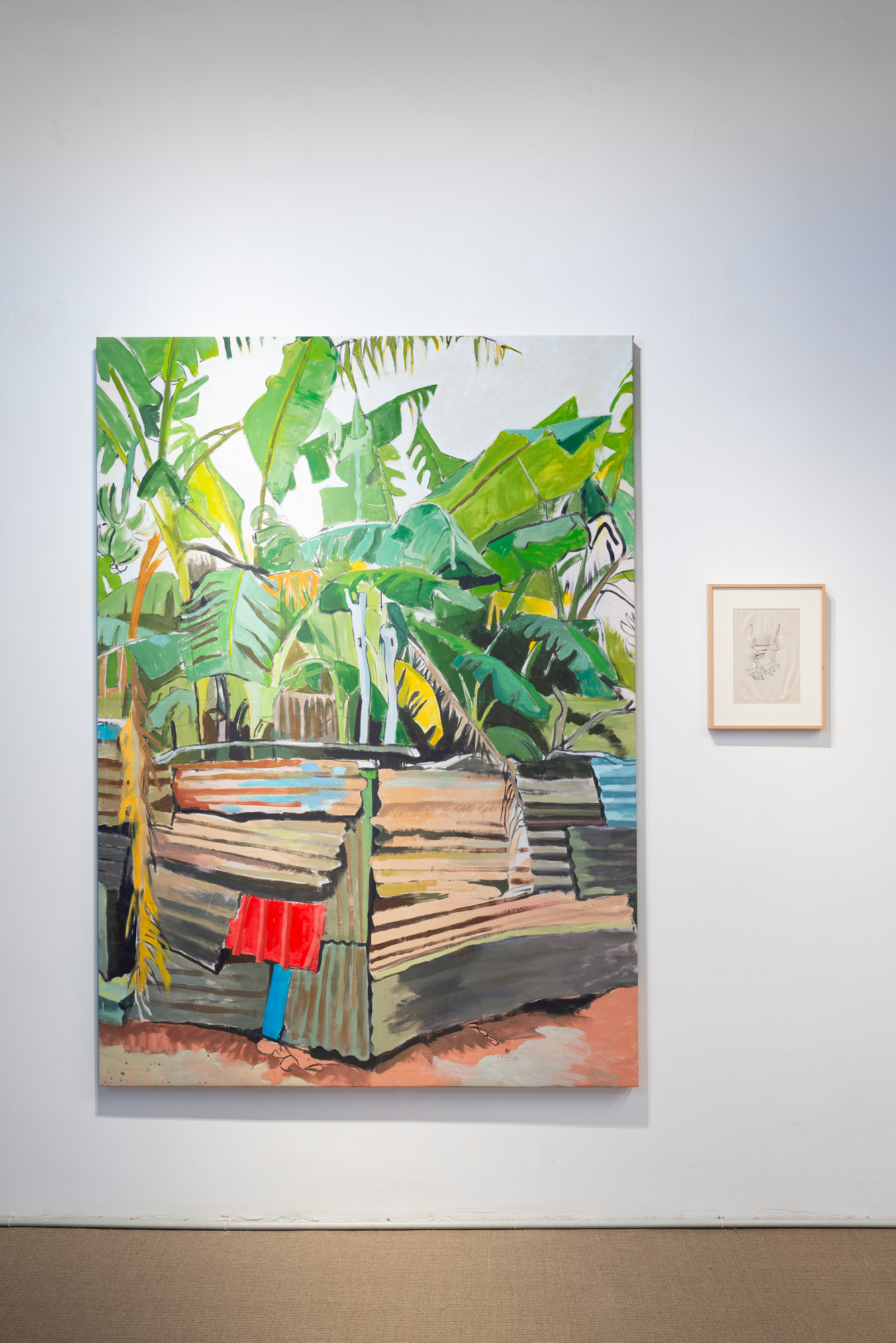
The rain saturated the air and distorted everything he saw. Humidity (unyevunyevu in Swahili) was everywhere. This is how Wasini, a small and modest island in Kenya, welcomed Tomàs Pizà in June 2024. The exotic gaze of the European undergoes a strange first encounter. Water from the sea, the sky, the ground—water in the air—frames the painter's meeting with his primary aim: to capture light and landscape. A landscape dotted with fragile constructions, in a semi-wild state and marked by the abandonment of public space, with too much plastic.
The series of small ink drawings emerges from paper that had absorbed moisture and later dried, creating slight undulations that once again confront the artist with the presence of water. For anyone else, this paper would have been discarded. Without altering the background, Pizà begins to draw chairs, beds, benches, and small precarious structures. The drawing is precise, surgical, architectural, stripped down, freehand, continuous, at times trembling. Chance caused coconut water to mix with the ink, producing blurred stains with pinkish tones—accidental specters that give the bare images a new character and personality. This group of drawings forms a path of transformation for the artist.
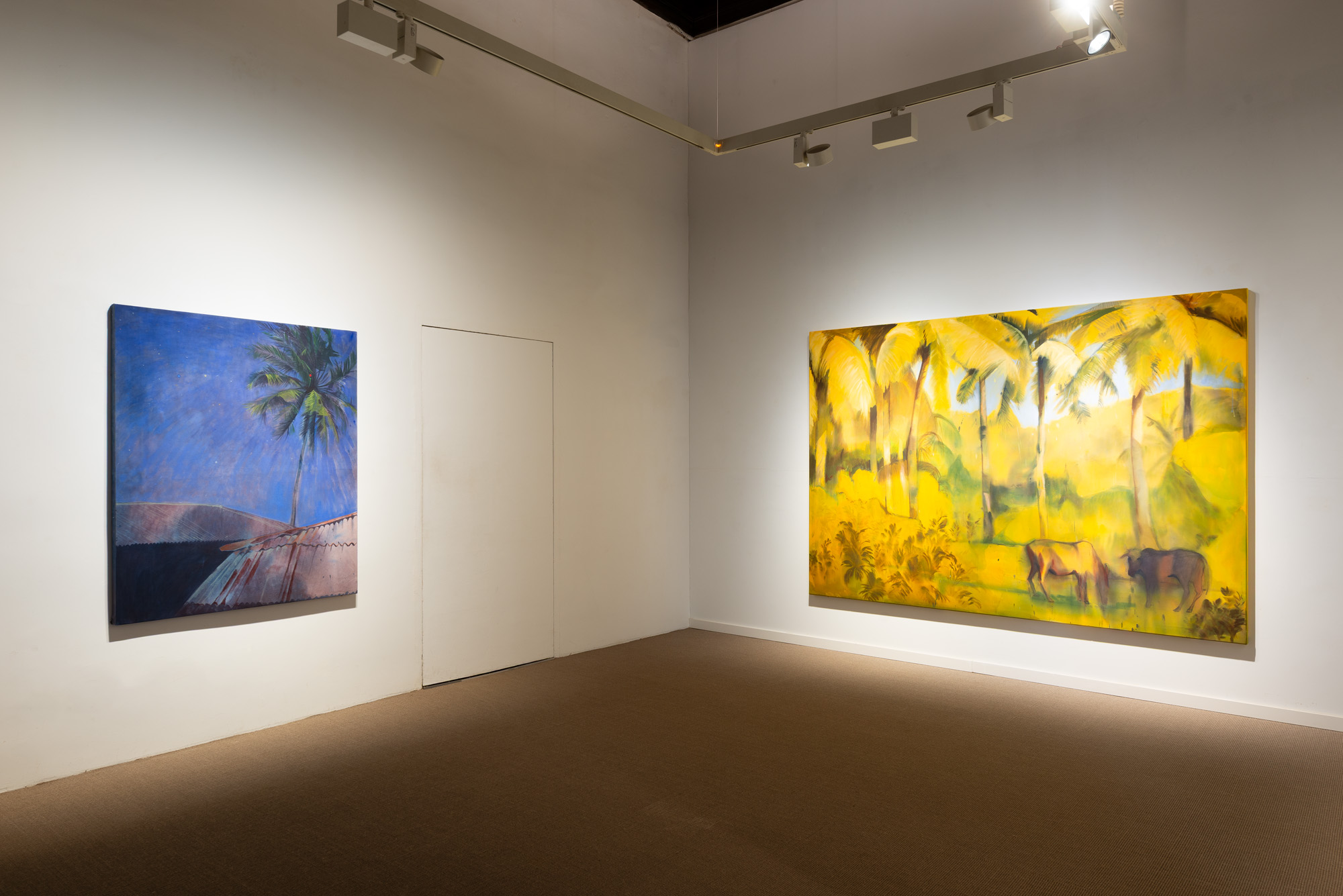
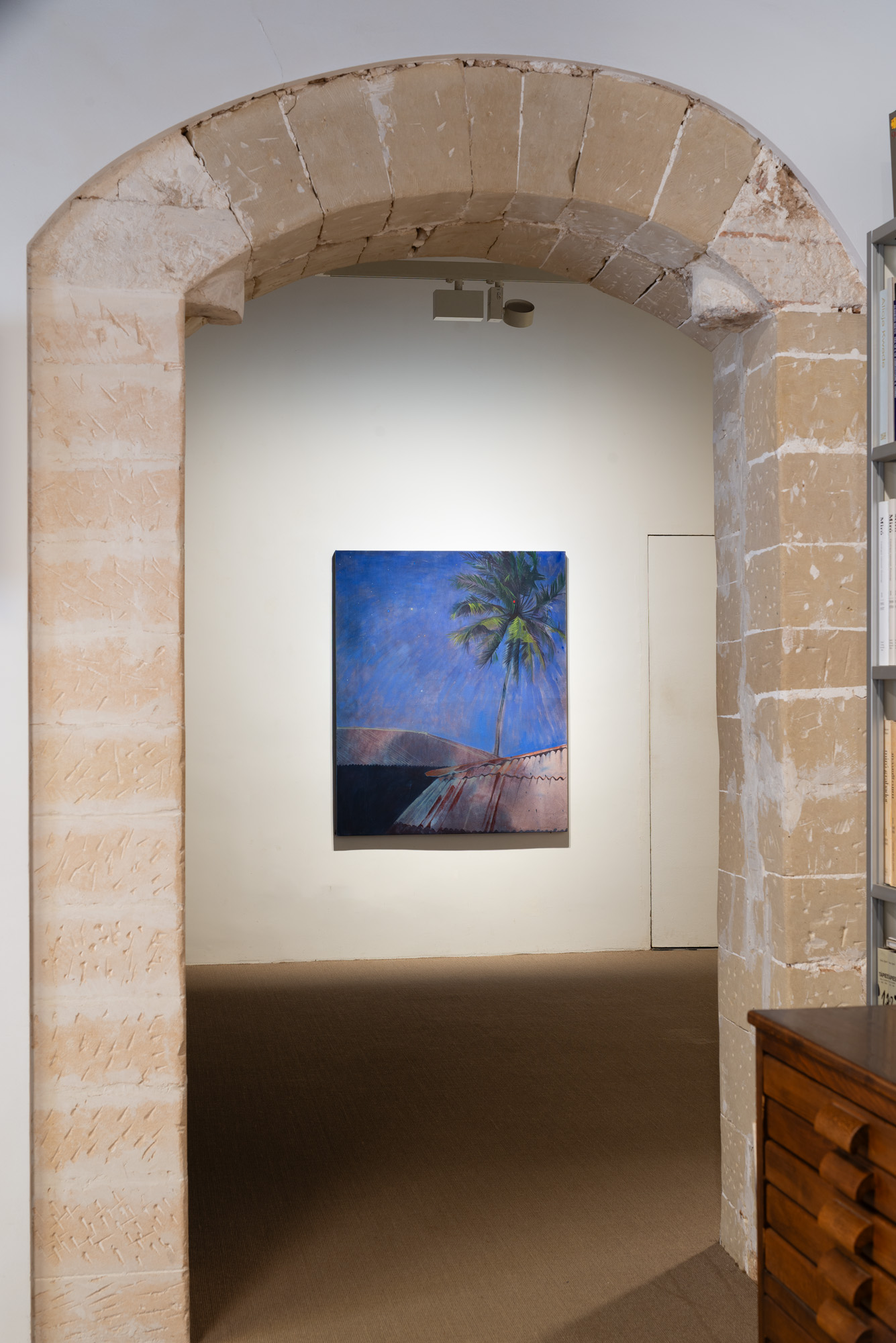
Other drawings arise when he lifts his gaze and sees palm trees. The low-angle view crops a fragment of the upper, more exuberant part of the tree. Pizà becomes obsessed and encounters, once again, an imported species in a territory—a migrant species colonizing a remote and humble African space, without electricity or vehicles. Why has someone decided to make the island more exotic? And yes, as always, the tourist imaginary manages to reach everywhere. Perhaps for some, baobabs and mangroves were not attractive enough.
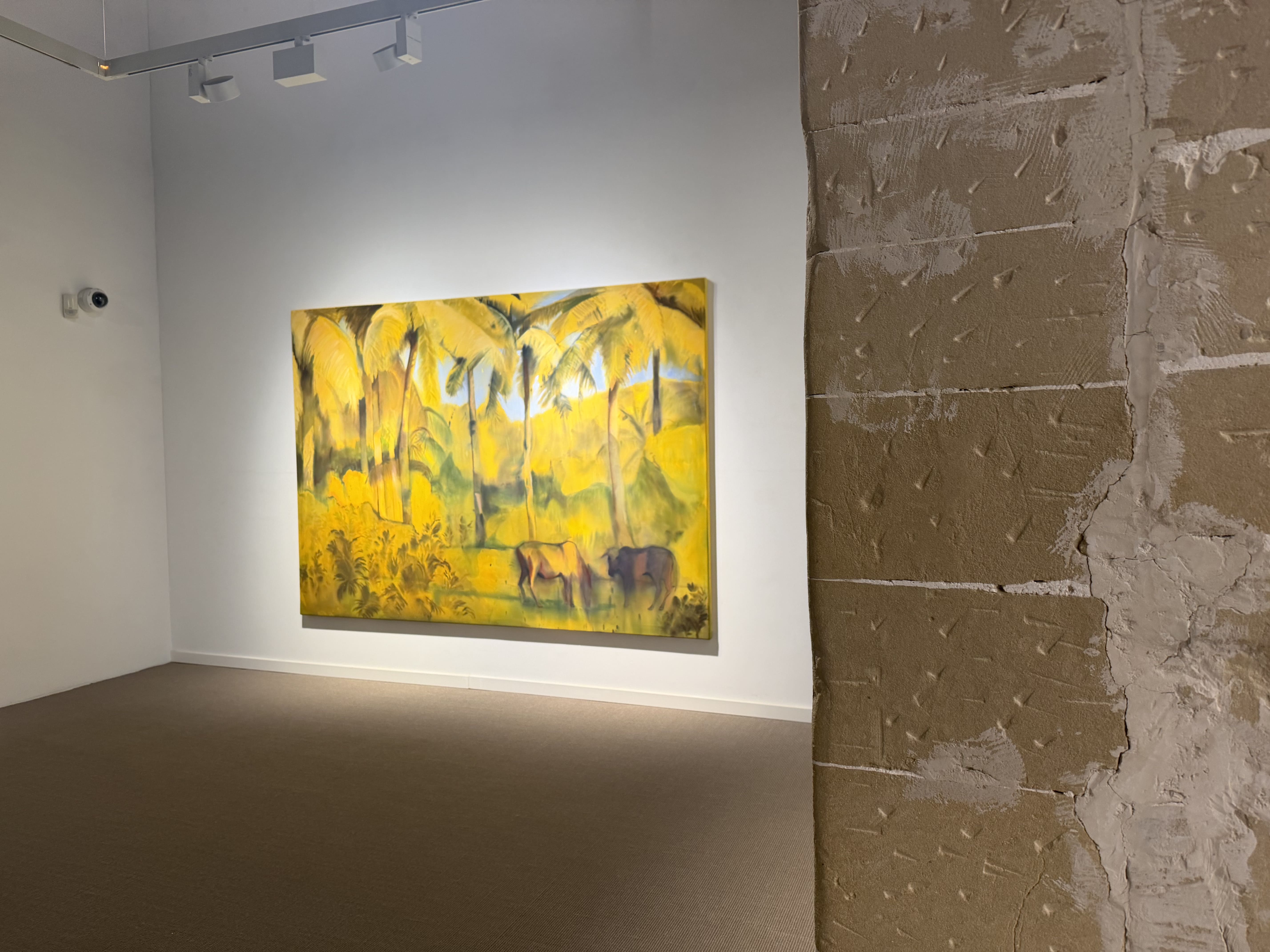
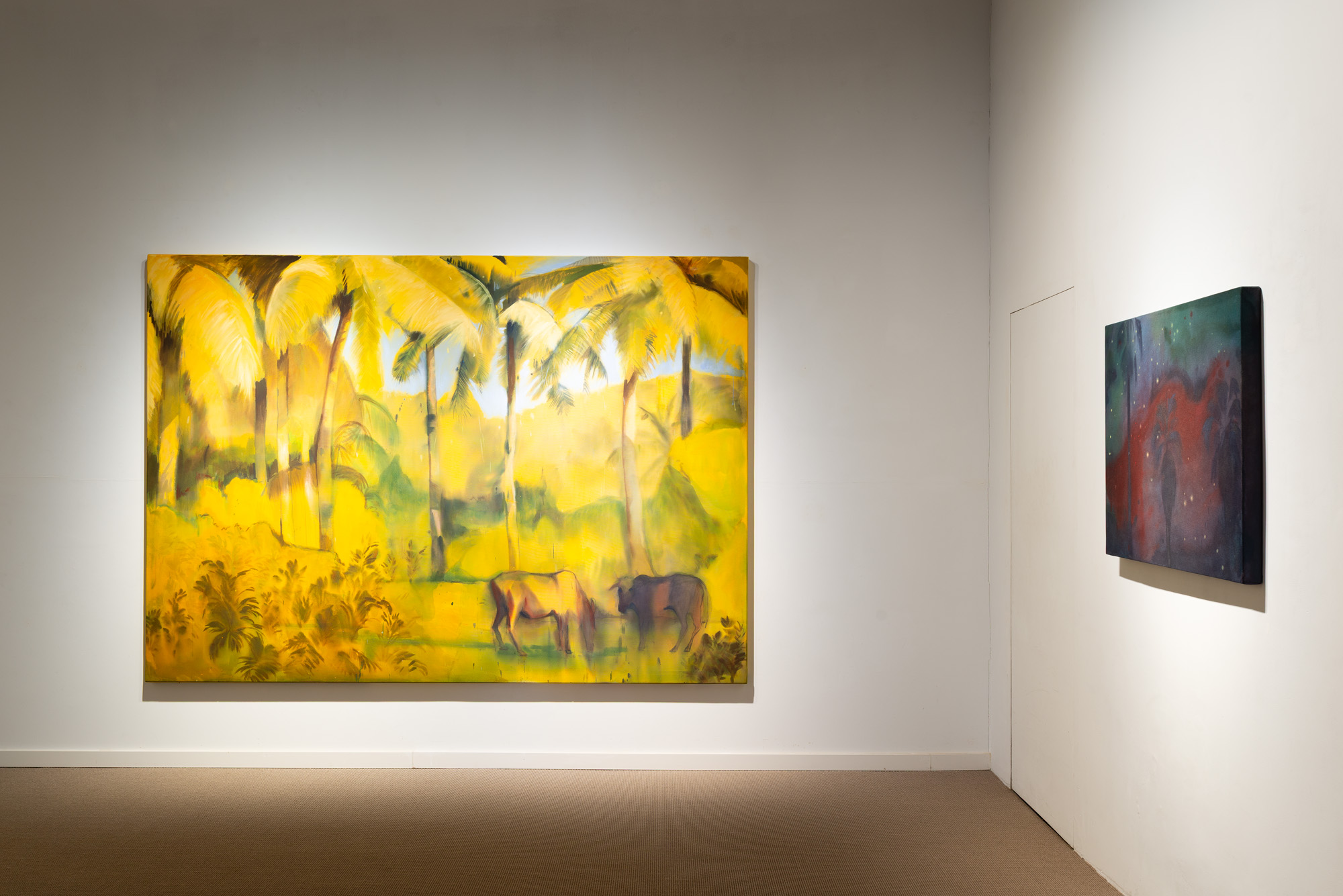
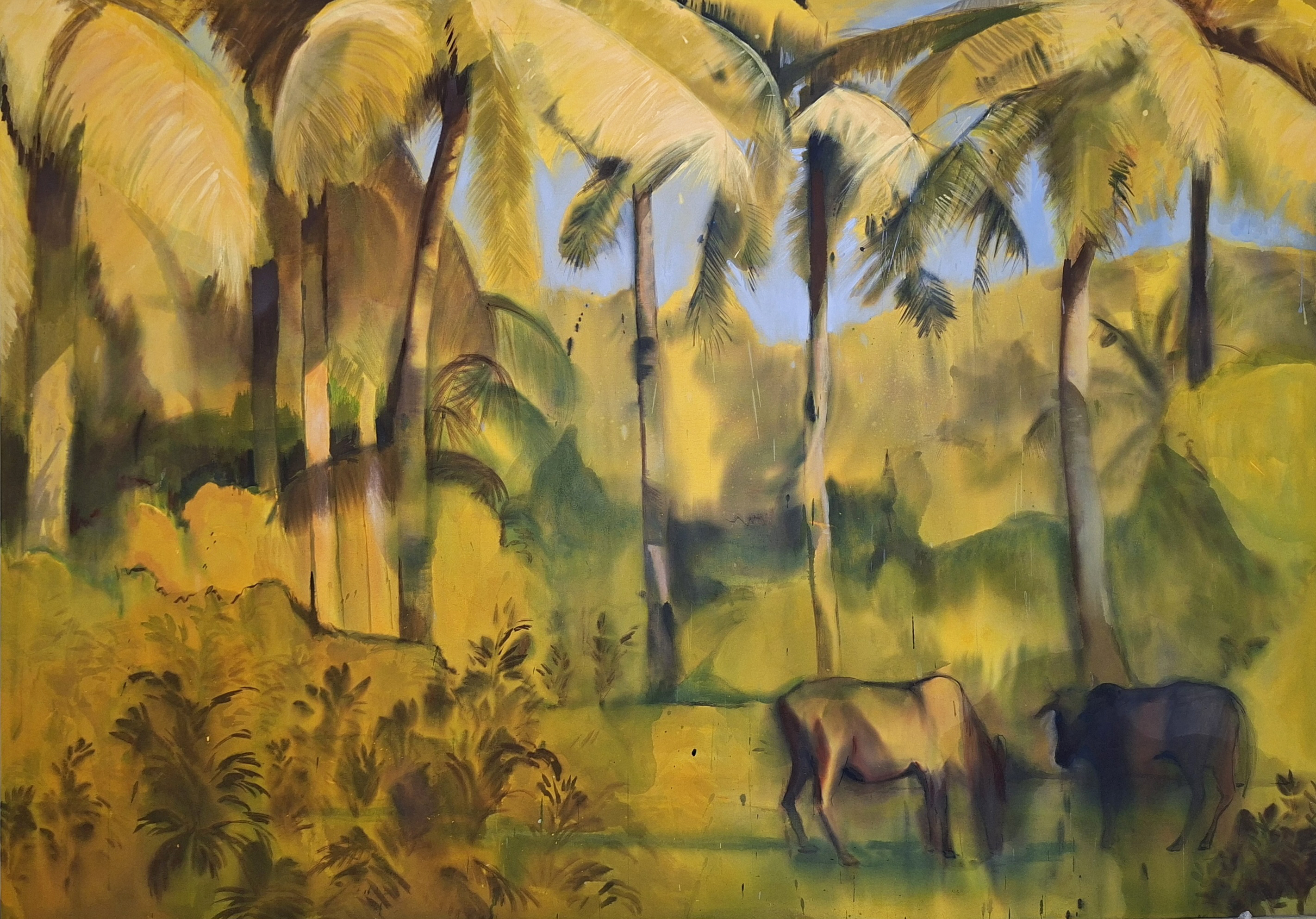
Tomàs Pizà paints from photographs he takes of the places he inhabits or encounters. Later, once off the island, he undertakes the task of creating canvases in the studio from these starting points. However, a group of paintings initiated after the Wasini experience—now shown for the first time—introduces substantial changes compared to his previous work. The compositional structure loses the precision and finish of earlier pieces; it gains uncertainty and provisionality, doubt, and this shift opens new paths in his practice. In a low sweep across the surfaces of this emerging phase, we observe evaporation, spreading stains, and spaces that appear blurred and dissolved. The compact, accumulated pictorial mass now yields to diffusion and glazing. Pizà almost has to unpaint rather than paint—or stop painting altogether. This is the new and suggestive challenge. Construction and definition lose strength, and other concerns emerge. The ease of closed drawing and brushwork moves to the background as he embraces the discomfort of sultriness; this aqueous, dissolved state of the canvas reveals unexplored and subtle territories pointing toward new atmospheres… everything that water leaves behind.
A wide spectrum of sediments in the water appears forcefully, marking structures filled with stains and nebulous, more or less material forms. The tiniest tropical residue becomes the subject, the structural axis. Addition turns into stripping away.
And what about light? Where are the aggressive midday daylight tones? Pizà moves into new lights—grayer, less yellow, darker, less defined, more diluted. The treatment of light is a fundamental tool in a landscape-oriented gaze like Pizà's, and the aqueous environment of small Wasini determines the works that attempt to capture it. Other works directly feature nocturnal backgrounds of blues, reds, and singular residual mixtures.
The central piece of the exhibition, larger in scale, is a clear example of the transition between what is lost and what remains, still echoing elements of the old world and others that foreshadow the new. In paradox 23 of The Logic of Sense, Deleuze observes the opposition of time as Kronos and Aion: the former as the assertion that only the present exists, with past and future relative to it; the latter as a conception where only past and future persist, and the present is infinitely divided. And perhaps it is within this time of the event that Tomàs Pizà now finds himself—painting his own life, opening to uncertainty, shedding his skin.
_____
Tomás Pizá (Palma de Mallorca, 1983) develops an artistic practice situated at the intersection of painting and architecture. His work explores the relationships between landscape, territory, and memory, paying attention both to urban environments and natural landscapes, as well as to the transformations introduced into them by human activity.
He studied architecture and Fine Arts in Madrid, Milan, and Alghero. In 2009 he obtained his degree in Fine Arts, and in 2012 he qualified as an architect in Madrid. Between 2017 and 2019 he attended the unofficial master's program of the Turps Painting Programme in London. Afterward he returned to Mallorca, where he currently lives and works in Palma. He is a lecturer in the Building degree at the UIB and in Fine Arts at ADEMA-UIB, combining teaching and contemporary art with professional architectural practice.
La Galeria Pelaires ha rebut una subvenció del Consell de Mallorca per a la realització d'aquesta exposició.