From June 5 to September 11, 2025
First individual exhibition by Carlos Garaicoa at the main floor at Galería Pelaires
THE SPIRITUAL MATHEMATICS OF CARLOS GARAICOA
At the end of February 2024, Garaicoa presented his exhibition p=3.1416 in Madrid, a title that was initially confusing given that most of the works on display were abstract pieces with a markedly geometric profile. Another change of direction, I thought, given that Garaicoa has accustomed us to receiving the expansion of his imagination with a certain haste, to the point that we cannot recognise some of his works as his own unless we pay close attention to the body of new codes underpinning them.
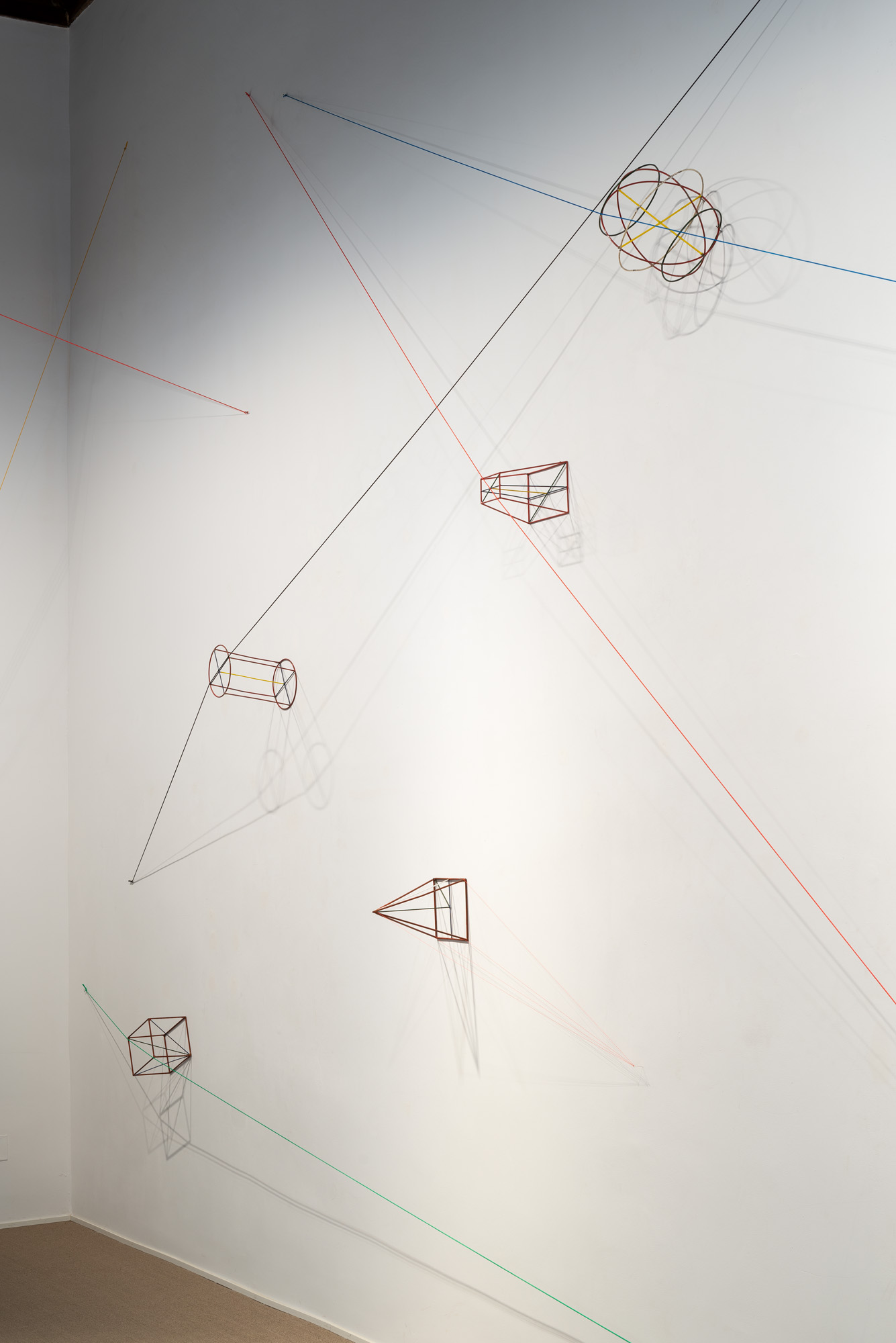
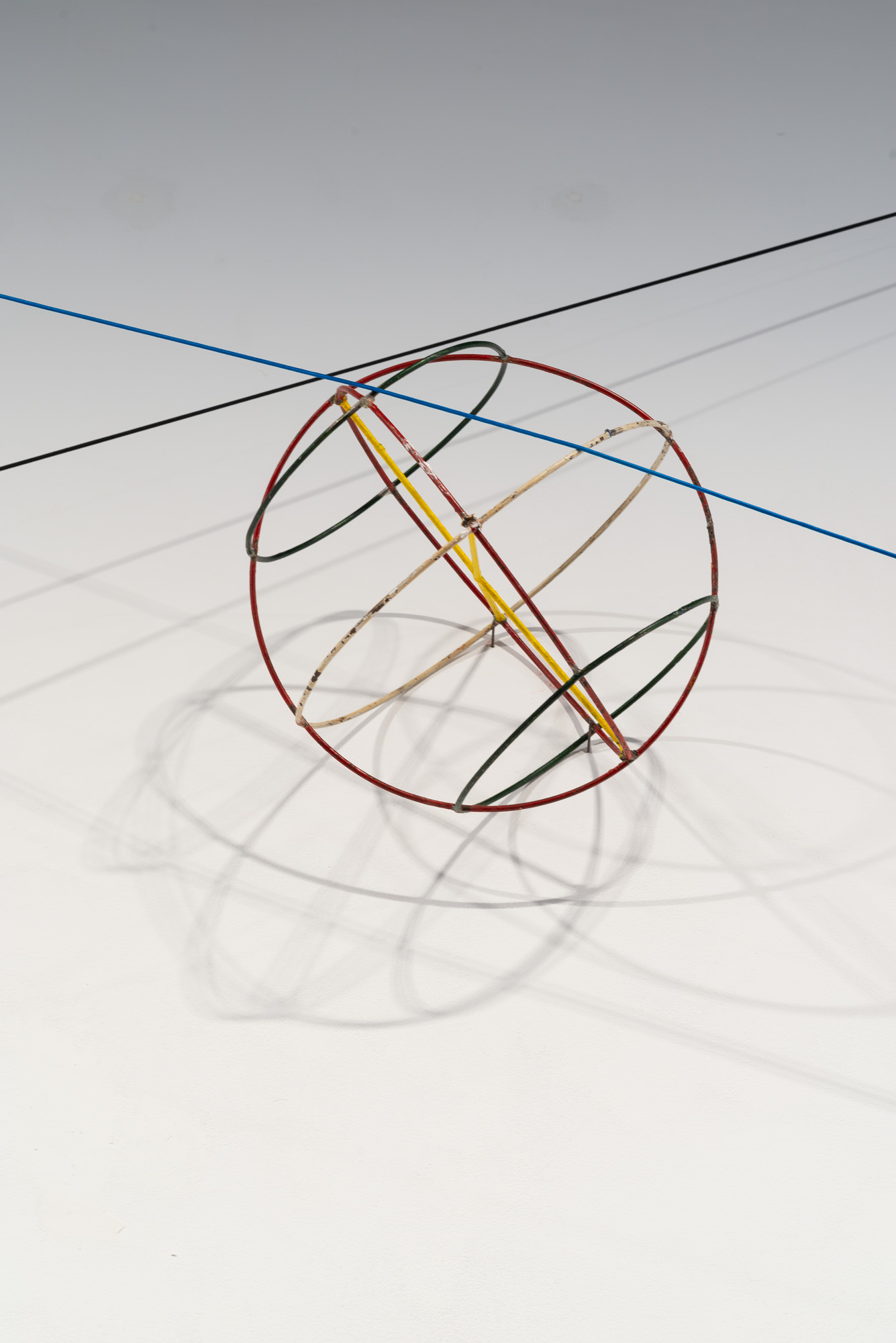
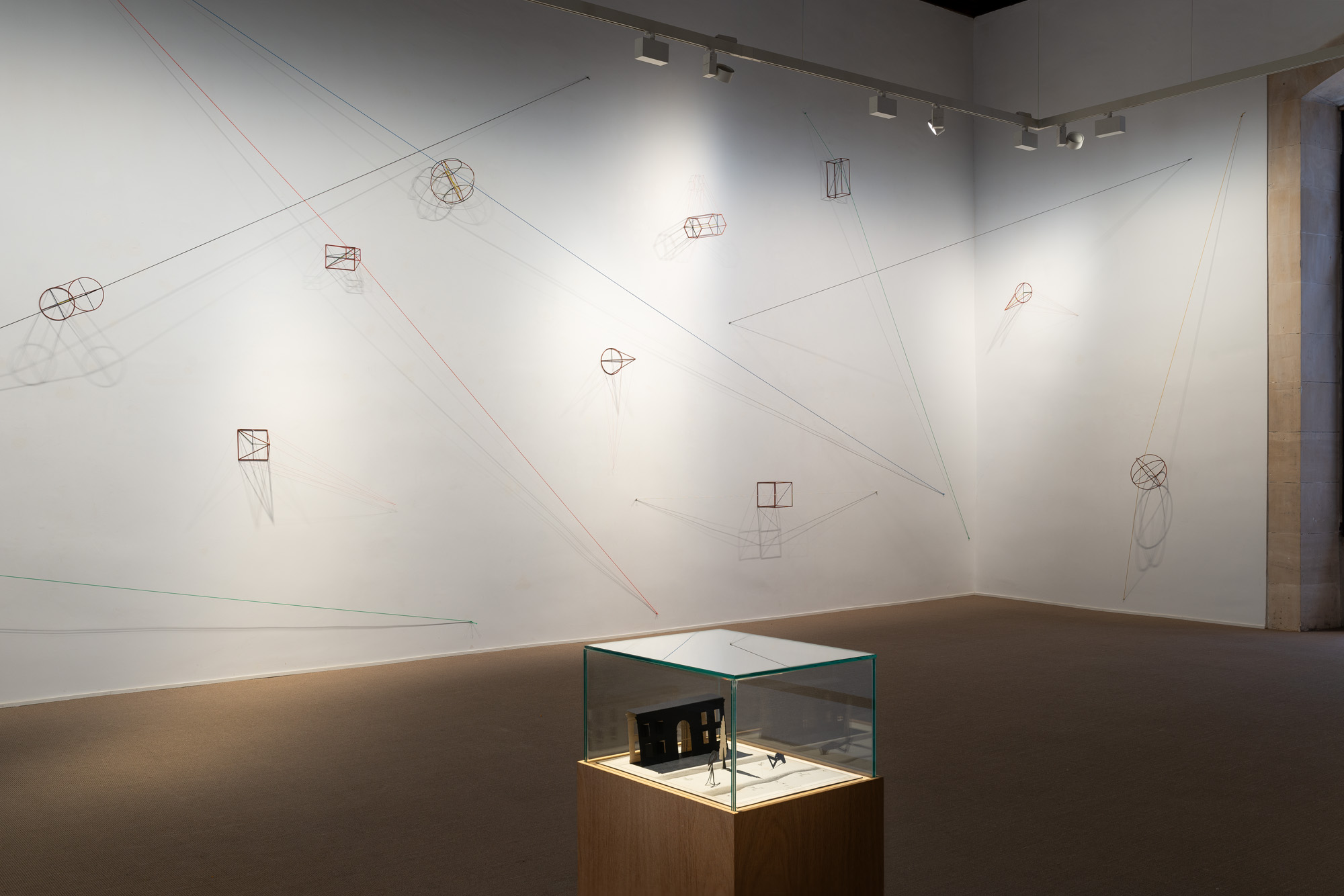
However, the approach to abstraction functions here more as a resource than as a proposal in itself. Carlos has not decided to enter fully into the abstract universe as a concrete proposal; in fact, if we analyse his more or less recent work, we find several examples of abstraction that were not foreign to him. At least not entirely. In 2018, he presented La lección de geometría (The Geometry Lesson) at his Madrid gallery, an installation tailored to the space, made with threads, coloured strings and pins, vaguely reminiscent of the spirit of the Ttéias by Lygia Pape, one of the great voices of the Brazilian neo-concrete movement, of which Garaicoa is a self-confessed admirer. The differences between the two installations are enormous; Pape, faithful to the precepts of neo-concrete art, sought the active participation of the viewer, her gold and silver threads were practically invisible to the point that one of the great challenges of this series is knowing how to illuminate it, and she often used a much larger scale. Nevertheless, between the two works there is a common objective that goes beyond what is apparent, a capital truth related to the illusion of planes and forms: an order that is clearly unfinished. And it is precisely on this exercise of awareness that Carlos now focuses particularly, seeking the relationship between the whole and the parts, a philosophy that involves the use of resources such as geometry to explore the proportion and interconnection of things in the manner of a spiritual mathematics.
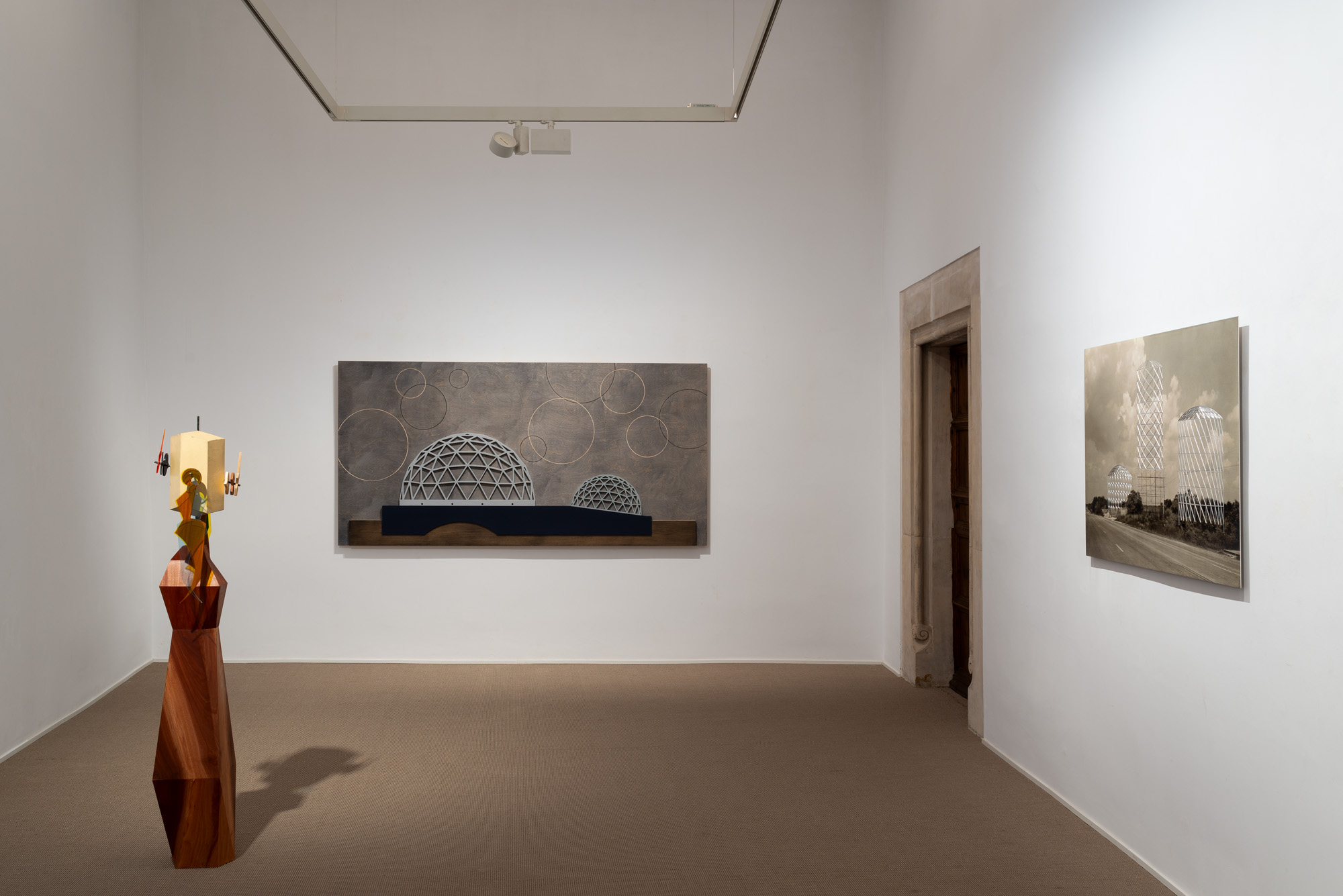
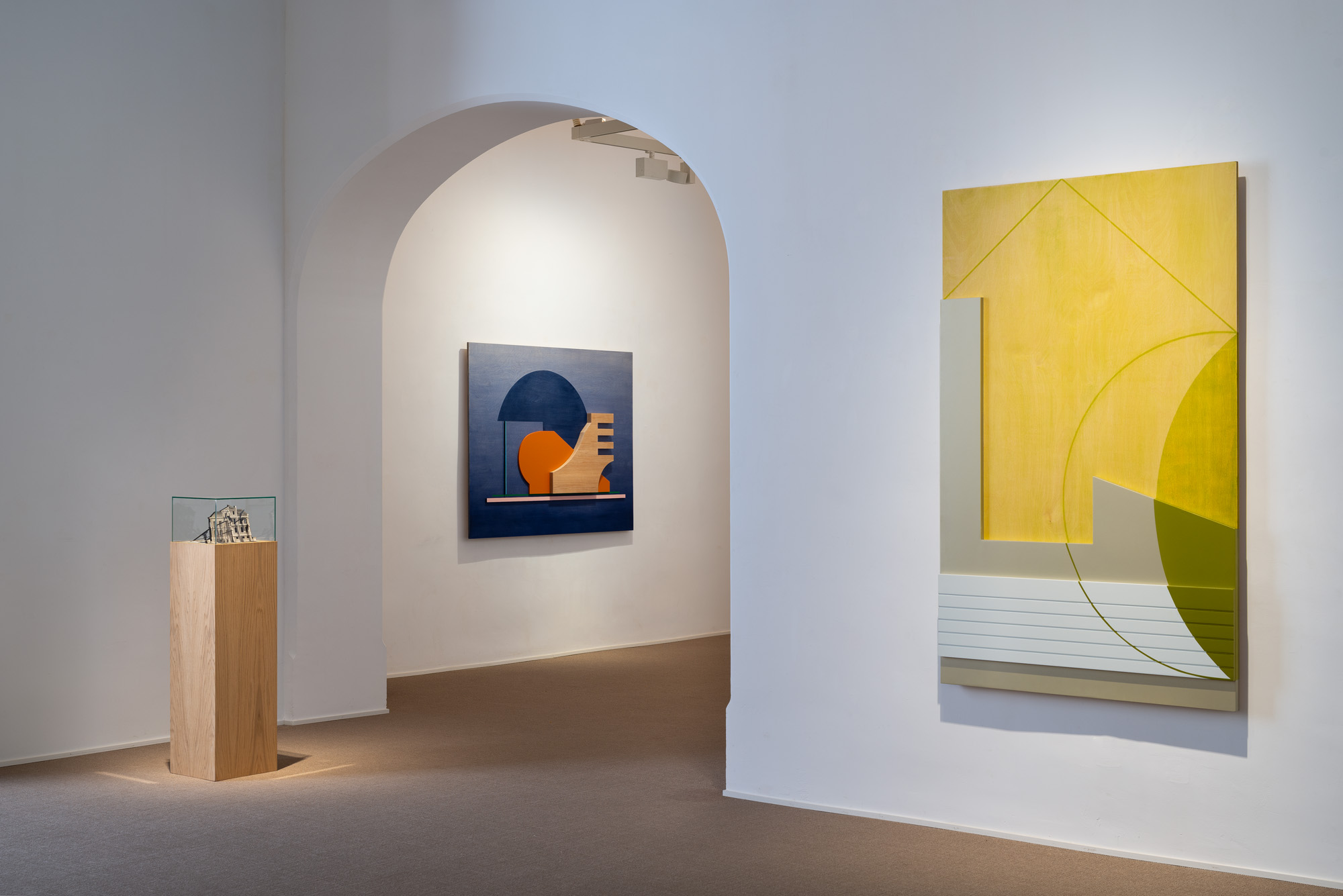
Seen in perspective, the ten reliefs exhibited in Madrid could be classified as works in transit, functioning almost like an overture. In musical terms, they would begin to be interpreted with the curtain still closed. Let me explain. The very condition of the reliefs, halfway between two and three dimensions, blurs the boundaries between painting and sculpture and places us in an ambiguous territory that is hard to define, but at the same time sets the tone and atmosphere, as in the case of overtures, for us to breathe in the themes that are approaching, that are about to arrive and that are irreplaceable when it comes to exciting us and creating expectations.
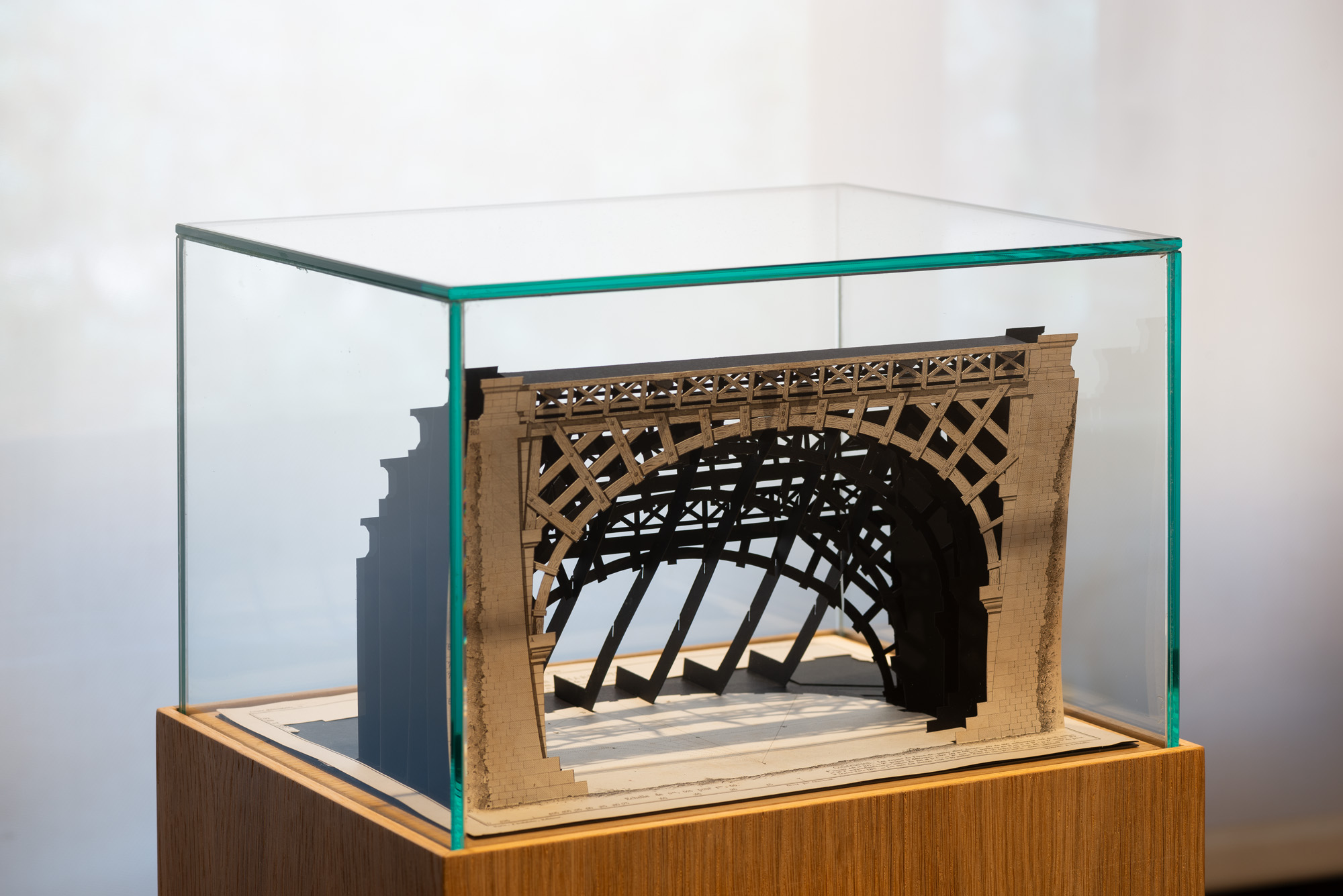
His reliefs function as a kind of preparation; without them, it would be difficult to understand the subsequent sculptural series that develops within the three-dimensional convention of new syntax, with hypertrophied bases and more organic pretensions. Initiated in 2024, this new series has as its unifying element a series of small cardboard models made in Austria around 1900, which the artist acquired from a German antique dealer and the original purpose of which was educational: they were used to teach crystallography, the science that studies the external geometry of crystals, their internal structure and chemical composition. The models are inserted into the sculptural body with apparent ease, establishing a kind of tension between the plant world and the scientific world. Garaicoa's new sculptures are a successful example of the changing role of sculpture in artistic practice, of the incorporation of unconventional materials in the creation process and, ultimately, they encourage us to continue questioning what sculpture is today in the absence of a precise definition.
Garaicoa's abstractions could formally refer to the irregularly framed coplanars developed in the 1940s by the Uruguayan Carmelo Arden Quin or to the rigidly supported reliefs and cut-out forms of Gregorio Vardanega. However, unlike these, their effect has more in common with the forms of Jean Arp, where the result of the composition was more linked to random shapes. Garaicoa manages to bring together two traditions, two moments and several meanings: he rescues the formal aspect from the Western heritage, whereas the intentions and spirit have more to do with Latin America. And all this is immersed in a play of essences and appearances that a discerning viewer should be able to perceive. In this field, moving a circle a few millimetres within the composition is crucial in order to achieve the order of things.
An abstraction that becomes contradictory, sacrilegious and irreverent when he decides to draw a small cloud in the top left corner of ? (Delta), a piece created in 2023 as part of the exhibition held in Madrid. The importance of ? (Delta), an acrylic painting on birch and pine, within a series that was initially intended to contain no more than the twenty-four characters of the classical Greek alphabet, is fundamental. Here, the 'contamination' within the sacred territory of the abstract is deliberate (how else can we interpret the cloud?), as it gives us a clue and reveals the extent of the perversion of the fields. This breaking of categories, this walking away from the norm, also warns us of the artist's deliberate intention to redefine the geometric canon. Carlos does not take the discourse of traditional geometers at face value, and he does not care about it. This heritage demands that he transform it in order to tell something new instead.
There is another earlier example of his interest in the abstract medium, an example that is seemingly more imprecise because it limits itself to more documentary interests and to a specific medium (photography) that practically defines him as an artist.
Between 2008 and 2012, he revealed a series of photographs laminated in Plexiglas and aluminium under the title El dibujo, la escritura, la abstracción (Drawing, Writing, Abstraction), which was based on a documentation work carried out in Caracas in 1997. The final part of the title highlights his manifest interest in abstraction, this time of a lyrical nature. Photography is, a priori, the medium we most associate with Garaicoa, perhaps his most expensive medium, an 'unavoidable methodology in my work', in his own words. Photography is vital to understanding him, to such an extent that he has become interested in architecture and its relationship with politics and history through photography, which is, to date, the medium he uses most, the one he knows best and which he takes most advantage of. It is from this intimate knowledge that the complicity required to manipulate it to the point of fragmentation emerges.
Properly understood, Drawing, Writing and Abstraction are fields of exploration and exercises in which the use of abstract language has had little critical success. There are several moments in the series where we can pause to consider the abstract fact itself, such as in La Abstracción VI (Blood Wall) or La Abstracción II (roja), two large-size colour photographs. In both images, what is captured is essentially painting, but the remains and the ruins of the space that shelters them allude to the compositions of American abstract expressionism, a movement within post-World War II informal abstraction. In fact, both works can be read as an all-over, a boundless, open field where no space within the pictorial narrative is privileged. It is as if he had found, in the urban landscape that so obsesses him, a work by Franz Kline or Clyfford Still, as if in the middle of a Havana ruin, chance had placed before his eyes a Guido Llinás or a Hugo Consuegra, two founding members of Grupo Los Once (The Eleven), the first informal abstraction association that emerged in Havana back in 1953. Los Once, which takes its name from the number of participants in its first exhibition, went on to exhibit in July 1957, in their second phase, already disbanded as a group, at the Sardio Gallery-Bookshop in Caracas. Garaicoa, most likely unaware of the little-known anecdote about the arrival of the Cuban informalists in the Venezuelan capital, manages to find a subtle connection of appearances among the vestiges of an old Caracas market, a chance encounter where photography meets painting.
This type of encounter, in which the photographed subject takes on a path, a dimension far beyond the object or event portrayed, this play of multiple intentions can also be observed in two works that could well act as a diptych, although they were not originally intended for that purpose. Parque Infantil / Geometrías I and Parque Infantil Geometrías II, two black-and-white photographs measuring 110 x 134 cm, freeze the image of a semi-derelict playground in Old Havana, the neighbourhood where Garaicoa spent his childhood and early youth. It is not the swing bars, which occupy the foreground of the composition, but the background that draws the artist's attention: circles of colour roughly painted on the back wall, which connect us to the circular orders of Loló Soldevilla, the Cuban geometric artist who founded the only Cuban concrete group, which was short-lived but of great importance for island painting.
Carlos' playground also echoes Cuba, 1934, the only known photograph of Cartier-Bresson's brief stay in Havana on his way to Mexico that year: both are in black and white, with the same contrast between planes and photographing a playground in ruins. Cartier-Bresson and Garaicoa are also united by the desolation that pervades their images, a certain mystery that goes hand in hand with the surrealist spirit of Bresson's early years. It also establishes a direct link with his photographic past, because although Garaicoa works to articulate a discourse that is not explicitly read within a specific context, pieces such as this one refer back to the origins of his artistic production, where the city and its ruins form the genesis of a greater metaphor. In this playground, Garaicoa's past and future coincide in some way; it is an image that is both avant-garde and strictly contemporary, here is what he did, what he does and what is to come. It is a time capsule that we can read in different ways, associating it with different moments and intentions, as if he had found the connection between the whole and the parts in the manner of a spiritual mathematics.
Osbel Suárez
Madrid, winter 2025
La Galeria Pelaires ha rebut una subvenció del Consell de Mallorca per a la realització d'aquesta exposició.