

From July 25 to September 4, 2024
Girbent's solo exhibition at Pelaires Cabinet. Text written by Arturo Castro.
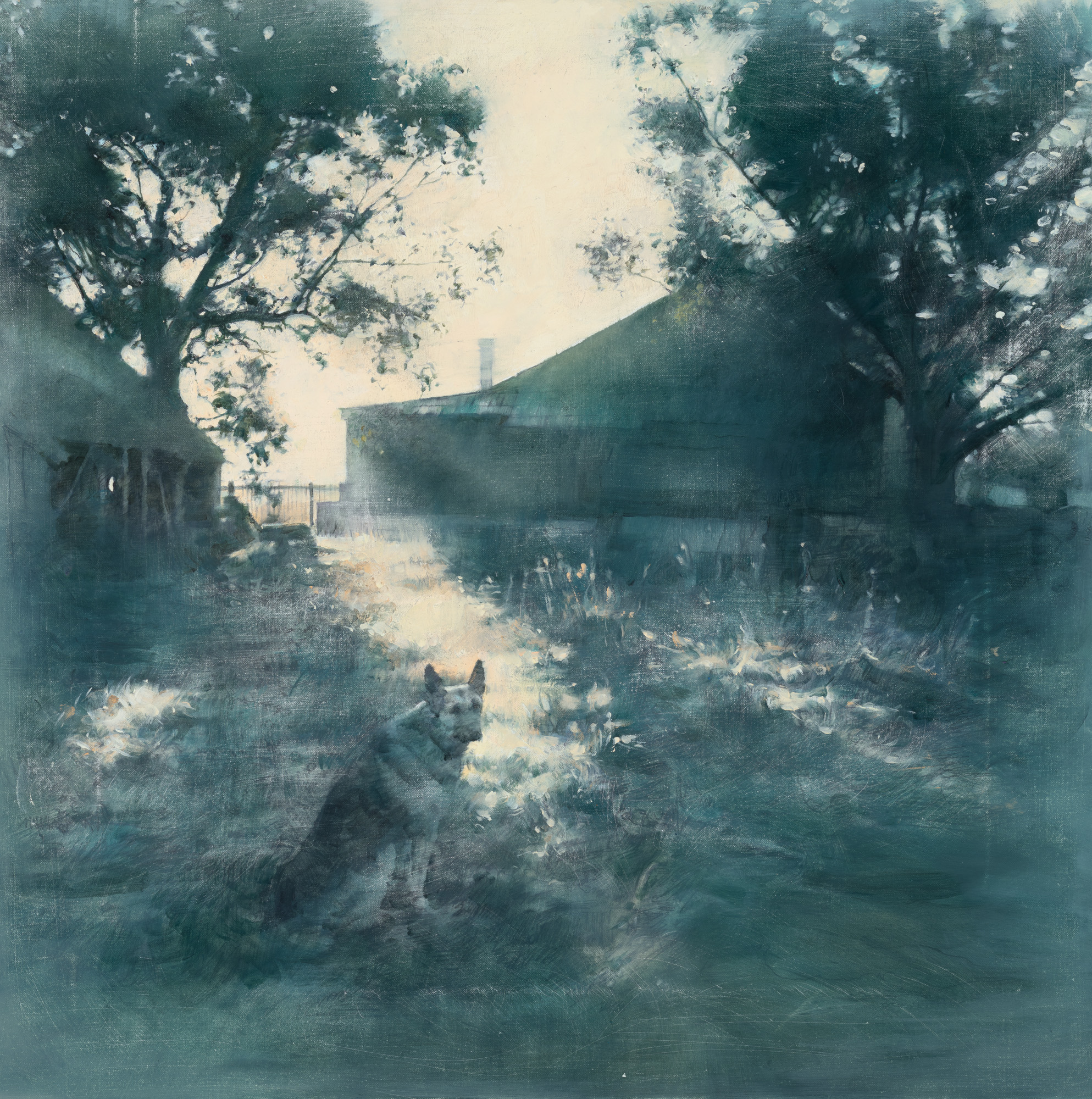
After revisiting Interior with figure from a contemporary perspective, Girbent now resumes another genre of our pictorial tradition: the landscape. And he does so using the poetic Polaroid photo landscapes by the Russian filmmaker Andrei Tarkovsky as an inspiration.
With his usual modus operandi, the artist has selected some pieces from Tarkovsky's Polaroid collection to propose a return of these images, to what most likely was their original source of inspiration: landscape painting.
The exquisite delicacy with which the artist approaches the conversion of these images into painting inclines me to think of a Girbent in love with Tarkovsky's trees. The artist engages in a pictorial translation of the images in pursuit of an ideal of beauty that is more Eastern than Western. In fact, one can trace in the series the influence of Tanizaki's classic essay on Japanese aesthetics, In Praise of Shadows (a work that Girbent confessed to having read). It is clear that, in these paintings, the artist explicitly abandons the unequivocal light of the Mediterranean (Western light, one might say) for a filtered, uncertain, faint light that barely manages to illuminate sombre, mysterious places...
There is a special attention to nuance in the half-light, in the subtle variation of shades in the dark. Rich shadow paintings in which a special emphasis is put on the textures and colour schemes characteristic of Polaroid photographs.
According to Girbent's own confessions, all this has been possible thanks to the process itself, which has developed its own criteria, showing to the artist the path to follow in order to achieve the best possible configuration of the proposal.
In short, the making of these landscapes has been a singular experience for the artist, who has been persuaded to abandon his preconceived ideas about the series to allow his decisions to be guided by the suggestions that emerged throughout the process itself. Girbent, who has become an interpreter of something that happened by the force of its own intrinsic development, has worked (out of unavoidable necessity) with a resource he had not contemplated a priori: the accumulation of time, time and more time dedicated to elaborating these sophisticated paintings. A good dose of poetic patience as the only way to reach the resolution that the proposal itself demanded.
What this series ultimately shows us is a Girbent who, this time around, has worked against his own inclinations by accepting the challenge presented to him, with all the consequences.
As if compelled by implacable extraneous reasons, Girbent narrowed down his initial selection of Polaroids until he came up with the final four, although the final series actually includes five paintings.
The artist has introduced another theme into this proposal through an apparently banal but decisive decision, changing the nature of the series by repeating one of the Polaroids in paint twice, thus giving rise to two different works that are based on the same image.
For Girbent, painting is (among other things) an unceasing creation of differences. Consequently, the artist believes that there are no copies in painting: everything is original.
The second pictorial repetition of the first of the four selected images radically changes the nature of this series of paintings compared to Tarkovsky's series of Polaroids, which is a finite series, as finite as the series of Polaroids ultimately selected by the artist.
However, this series of paintings has become potentially infinite.
To conclude, I allow myself a final thought...
Once transfigured into paint, these painted images begin to establish connections with the pictorial tradition (I sense echoes of Constable, Turner and particularly David Caspar Friedrich).
These are paintings with an undeniably classical appearance with which Girbent proposes his characteristic approach: radical contemporary art under a traditional guise.
The underlying message that I believe Girbent is sending us is the following: Let's not rush into labelling a work on the basis of the first impression, and let's pay attention to everything that is hidden beneath the surface. And the fact is that, beyond what is apparent, it is necessary to take a step back to look at the process leading to these small-size paintings, in perspective and as a whole: a modest but audacious process, a radically contemporary process.
Let's take a closer look at this process:
The original images that connect Tarkovsky's extreme sensitivity with the textures and colour schemes characteristic of Polaroid photography (a fortunate relationship) are now complicated by the powers of painting and those of repetition. And let's not overlook the intervention of another highly sensitive filter overlapping with Tarkovsky's: Girbent's own. An agitation of sending and forwarding swarms beneath the calm surface of these small paintings.
We sense a play with the image (the transition from one art to another) and perceive Girbent's usual apology in the background, what he calls "creating within narrow margins."
What remains is an unfolding of images in a different theatre: new singularities in which the interwoven concerns of two spirits overlap, like two voices whispering at different depths.
Having said all this, I can also confirm that paradoxes vibrate in these paintings: The images are the same and they are different, the landscapes are Tarkovsky's but also Girbent's… The paintings are classical and contemporary at the same time.
And ultimately, these paintings postulate a new paradigm. Let me explain: I understand Landscapes (after Tarkovsky's Polaroids) as a new tessera in the mosaic that Girbent has been creating for some time with his different exhibitions: The development of a pictorial proposal consistent with the rules of the game that govern the 21st century (the century of the internet and AI), a 21st century in which, in Art, all options are contemplated a priori and have displaced the central precepts prevailing throughout the 20th century to what we agree to call the "modern world". Precepts which, by the way, still maintain a powerful inertia in the mass media and among the general public.
In this sense, Girbent's work is classical in appearance and contemporary in essence, but not modern.
Arturo Castro
Views from the exhibition "Landscapes (After Tarkovsky's Polaroids)" by Girbent, Galeria Pelaires (Image by David Bonet, courtesy of Galeria Pelaires).


