From September 19th to December 12th, 2026
In Sal Divina Adivina, Claudia Peña Salinas continues her artistic investigation into territory, matter, and the ways in which cultures construct symbolic relationships with the forces of nature. While water, rain, and the Aztec deities Tlaloc and Chalchiuhtlicue have been central to her previous work, in this new body of work the artist shifts her attention to another fundamental element: salt.
Peña Salinas's interest in territories does not stem solely from their geographical or historical dimensions, but from the layers of memory, belief, and meaning they contain. Traveling, documenting, collecting, and transforming are essential processes within her practice, through which found objects, images, and materials are decontextualized in order to acquire new associations. In Sal Divina Adivina, this process extends into a more intimate and speculative dimension, where matter ceases to be merely a support and becomes an agent of transformation in its own right.
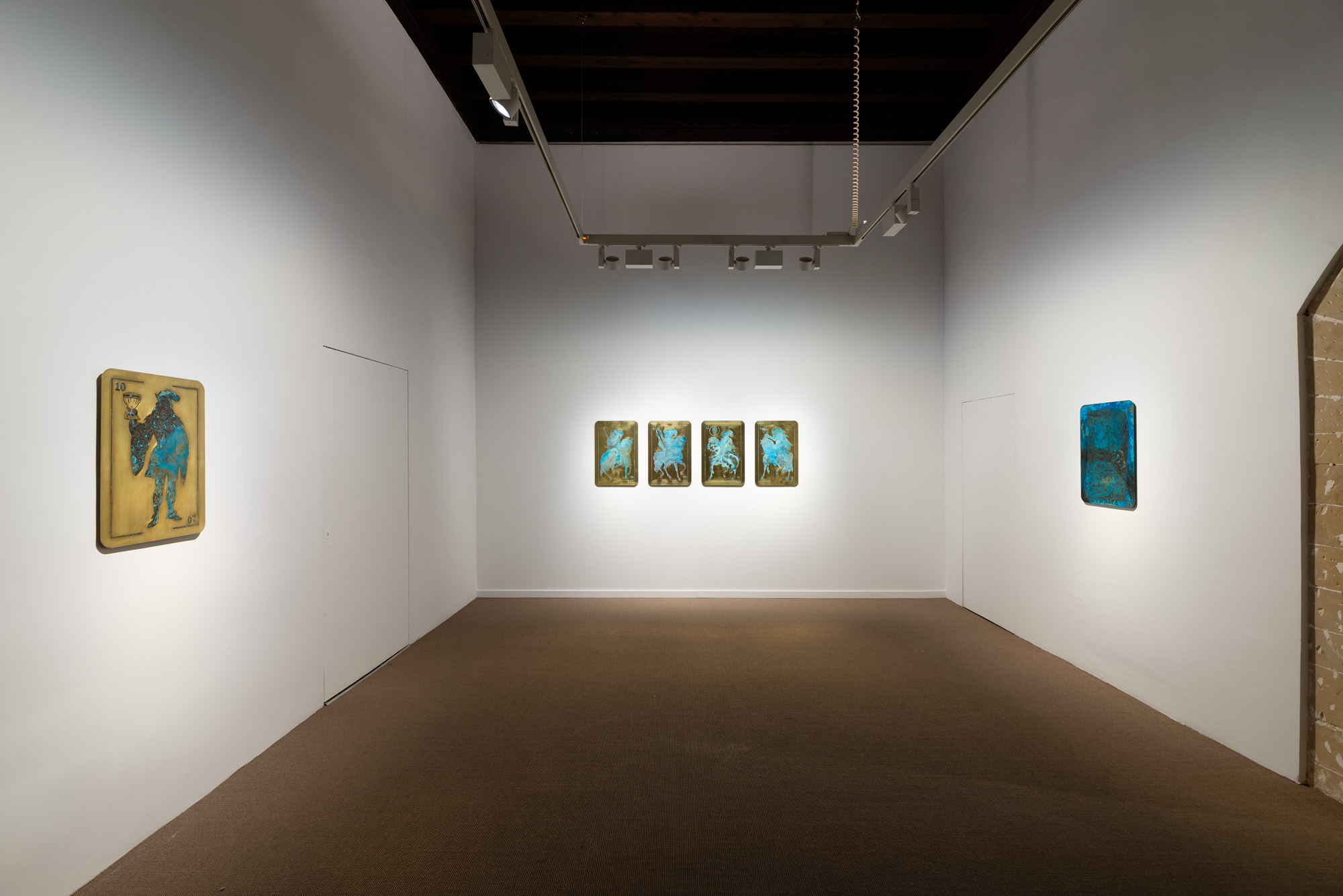
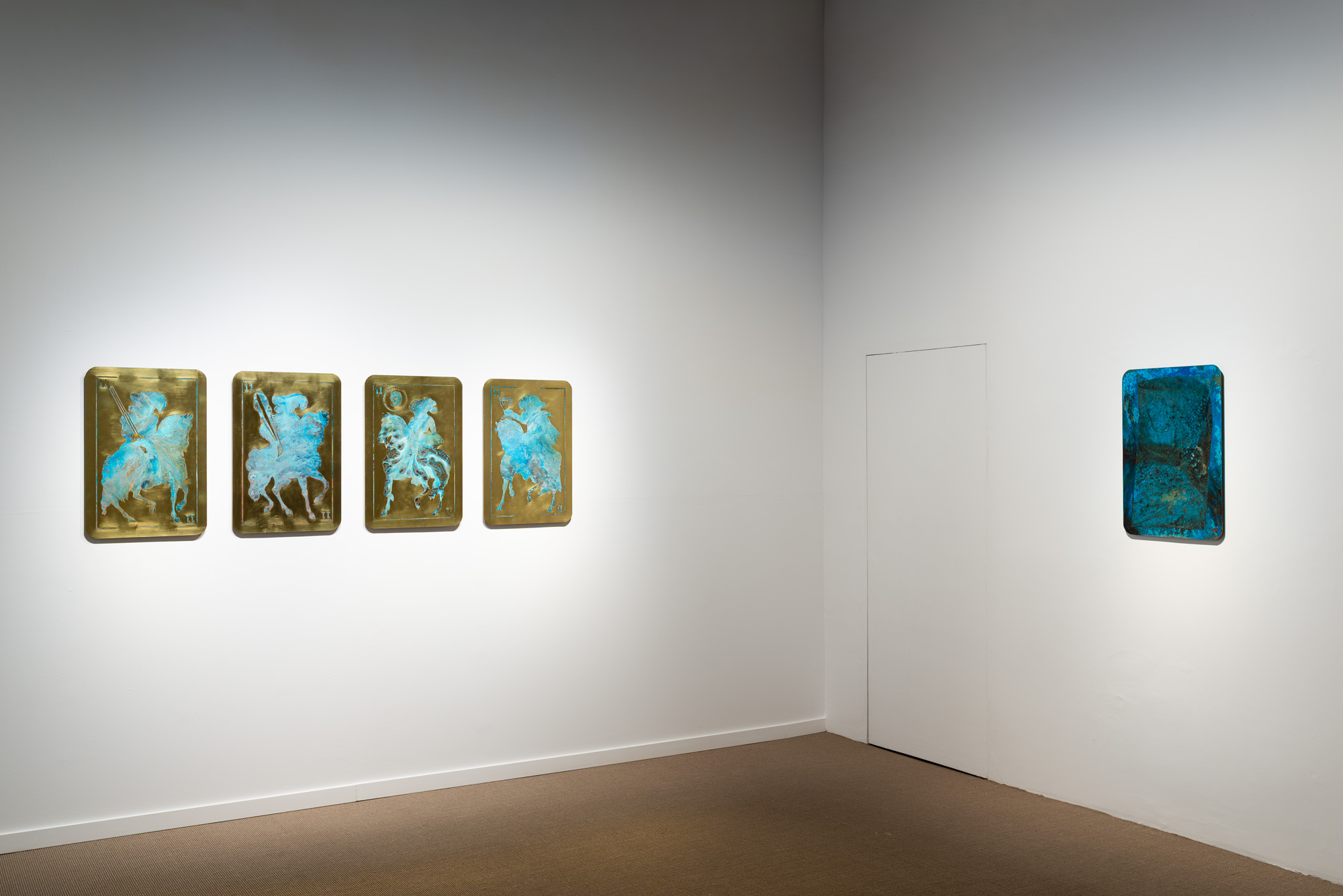
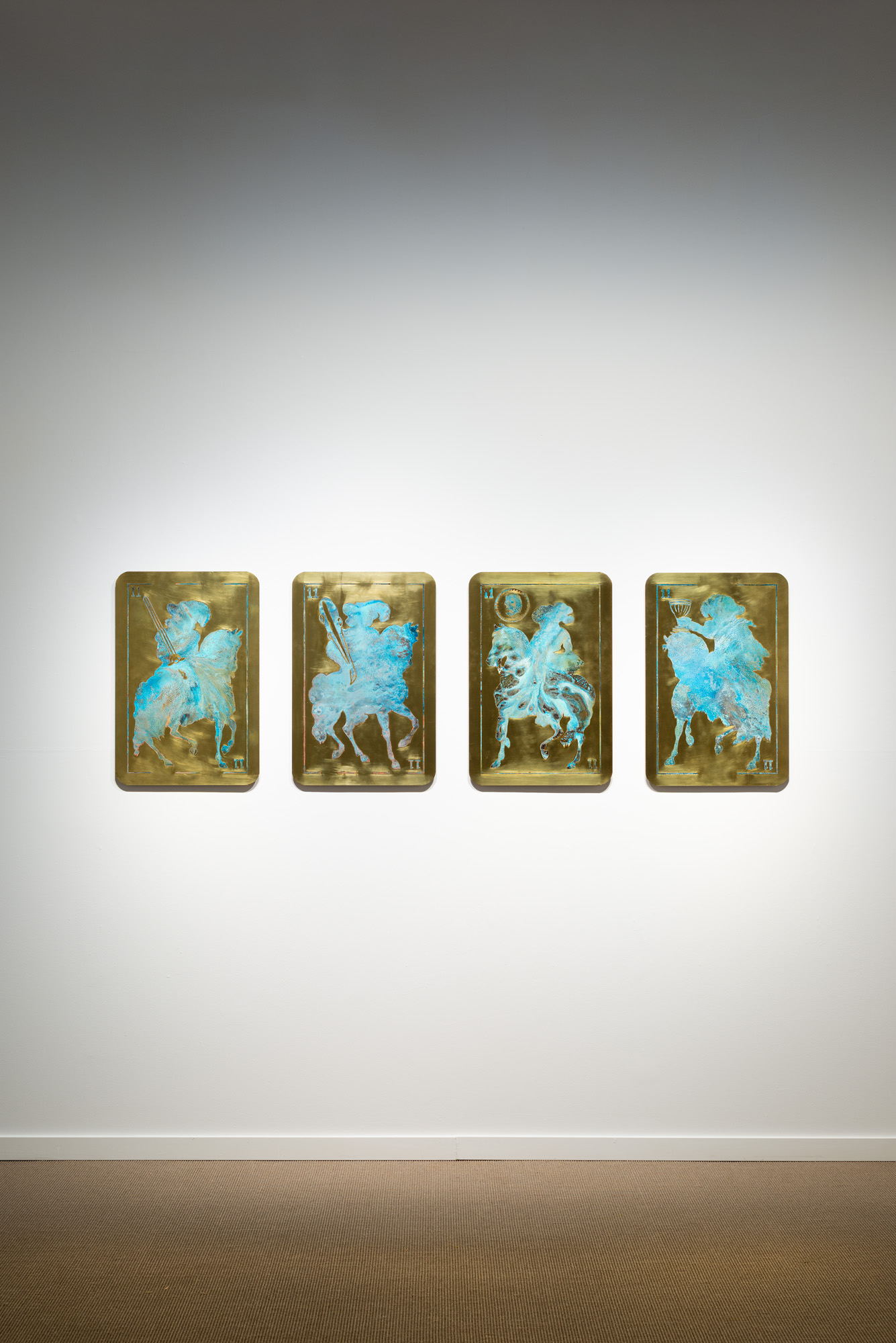
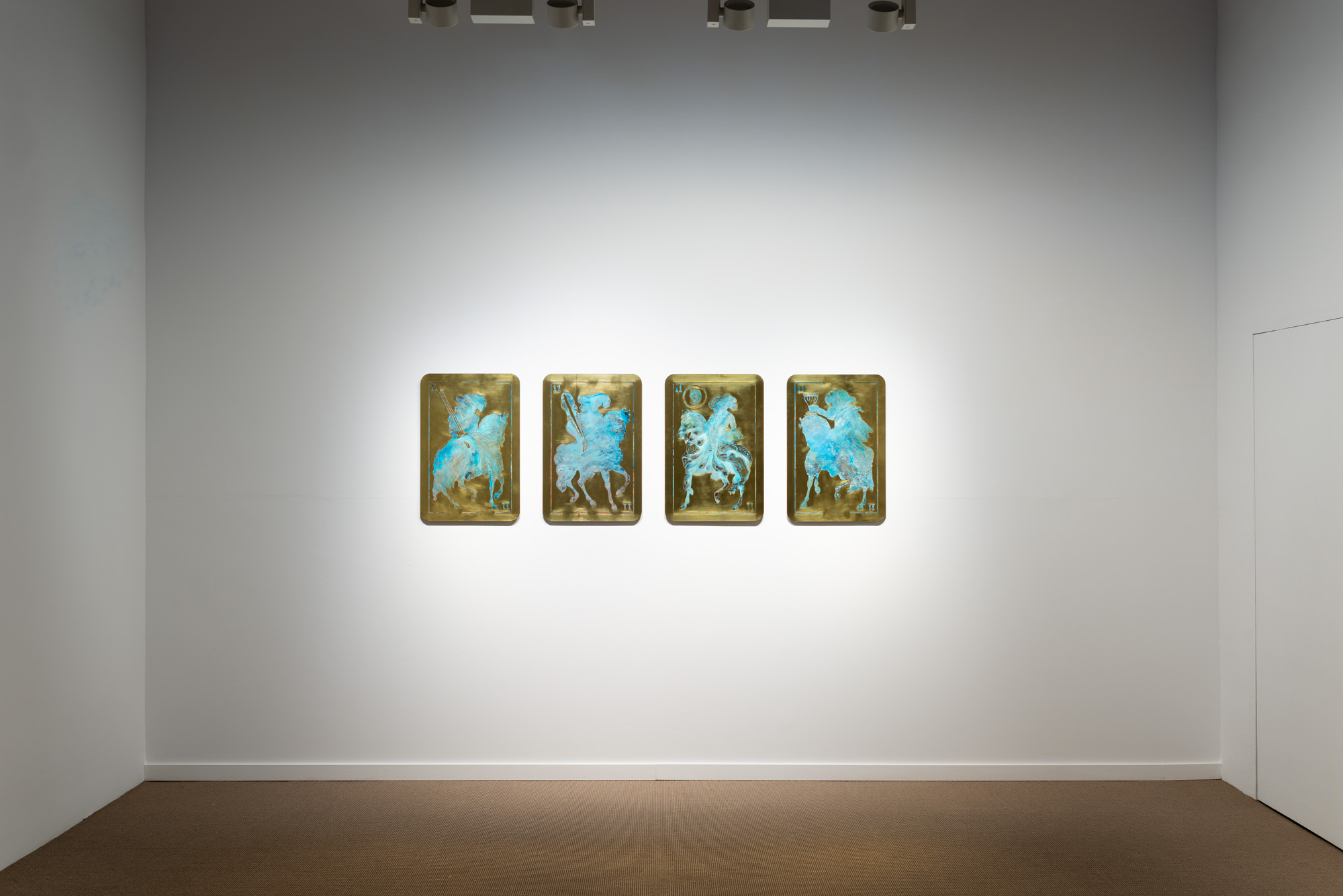
The exhibition takes the Spanish deck of cards (Baraja Española) as its point of departure, an everyday object that, beyond its recreational function, has traditionally been used in Mexico as a tool for reading, interpretation, and divination. In particular, Peña Salinas draws upon a Mexican deck from 1923 whose depiction of the court figures introduces an alteration to traditional archetypes. This seemingly simple modification becomes a gateway into questions surrounding gender, identity, representation, and the possibility of altering inherited symbolic systems.
From this universe of signs, the artist translates the language of the playing cards onto metal. Brass, treated through a chemical reaction produced by ammonia and salt from Mallorca, becomes a surface where intention and chance converge. The artist establishes the conditions of the process but does not fully control its outcome: corrosion, deposits, and chromatic variations generate unpredictable forms that ultimately become part of the work. In this way, matter actively participates in its own construction.
Salt thus acquires a dual dimension. On the one hand, it is a physical and territorial element, connected to the landscape and geography of Mallorca; on the other, it is a material historically charged with symbolic meanings associated with preservation, purification, protection, and ritual. In this encounter between salt, metal, and image, Peña Salinas proposes a practice akin to alchemy: a material transformation in which control coexists with accident, and in which the artwork can be understood as a space of emergence.
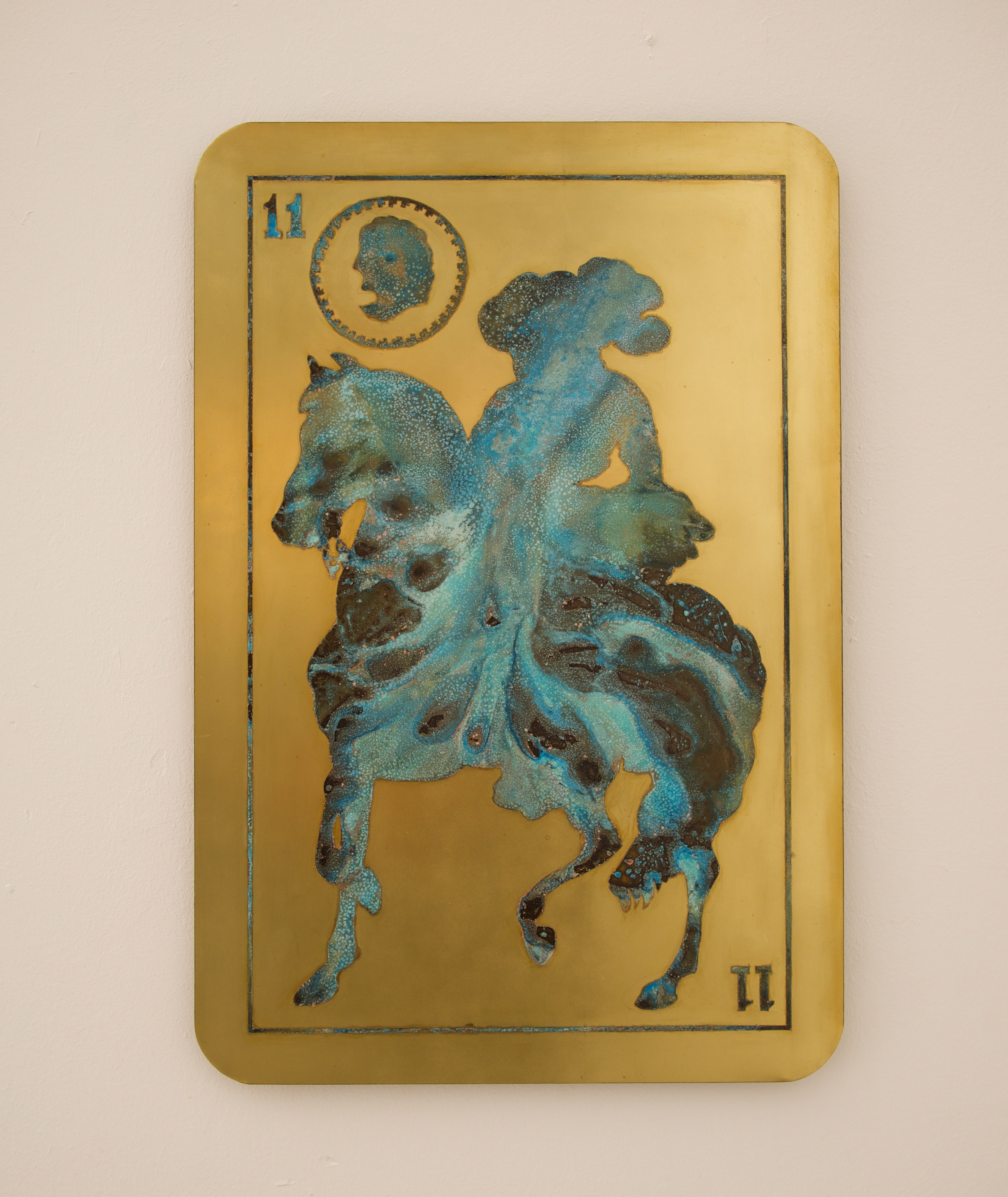
Claudia Peña Salinas, Caballero de Oros, 2026. Courtesy of the artista and Galería Pelaires.
Sal Divina Adivina
By Claudia Peña Salinas
«In Mexico and across Latin America, the Baraja Española is widely used for fortune-telling and divination, sharing deep symbolic and oracular roots with the Tarot. For this project, I am working with the 1923 El Gallo version of the deck, created by the French-Mexican businessman Clemente Jacques. Best known for founding Latin America's first food-canning factory, Jacques used his label-printing presses to mass-produce playing cards and the iconic Mexican Lotería. What makes his El Gallo deck unique is that he replaced the traditionally male pages (sotas) with clearly female figures, introducing a gender balance similar to the French deck's King, Queen, and Jack.
This subversion of traditional archetypes directly informs the artwork's physical creation. To mirror the deck's balance of human design and hidden fate, the images in this brass series undergo an alchemical process in which intentional form surrenders to chance. Combining ammonia with salt from the island of Mallorca triggers a volatile chemical reaction that permanently transforms the metal's surface. Through this chaotic interaction, a deliberate silhouette gradually emerges from an abstract pattern of deep blues, turquoise crusts, and blacks. Ultimately, this corrosion transforms the rigid brass into a scrying surface, utilizing the unpredictability of the elements to potentially encode a new hidden visual omen beyond those traditionally assigned to the figures».
La Sota (The Knave / Page)
El Caballo (The Knight)
El Rey (The King)
Oros (Coins/Gold): Represented the merchant class and economy.
Copas (Cups): Represented the church and clergy.
Espadas (Swords): Represented the nobility and military.
Bastos (Clubs/Staves): Represented the working class and peasantry.
La Galeria Pelaires ha rebut una subvenció del Consell de Mallorca per a la realització d'aquesta exposició.